PIRSA:C08021 - Science in the 21st Century
Subscribe to podcast
Science in the 21st Century
Organizer(s): Sabine Hossenfelder Michael Nielsen Lee Smolin
Collection URL: http://pirsa.org/C08021
Introduction: Science in the 21st Century
Abstract:
Date: 08/09/2008 - 10:00 am
Reference:
Speaker comments:
Tech Note: Audio Problems due to Echo Cancellation System Error
Talking to My Dog about Science: Weblogs and Public Outreach
Abstract: At a time when the great challenges facing our civilization are scientific in nature (climate change, sustainable energy, pandemic disease), improving the voting public's understanding and appreciation of science is more important than ever. I will argue that the Internet in general and weblogs spec...
read more
Date: 08/09/2008 - 11:00 am
Reference:
Speaker comments:
Tech Note:
Blogs, Wikis, MathML: Scientific Communication
Abstract: In the 1990s, the eprint arXivs fundamentally reshaped scientific communication in Math and Physics. In this decade, blogs, wikis and other, similar, tools are mediating an equally profound reshaping of scientific communication. I will talk about my own experience, as a blogger, software designer, a...
read more
Date: 08/09/2008 - 2:00 pm
Reference:
Speaker comments:
Tech Note:
Open Access Is Public Access
Abstract: This talk will review the public impact of developments in open access to research on education, professional practice, and public policy, with consideration given to legal, economic, and academic freedom issues, as well as to the very design of scholarly communication systems. The Public Knowledge ...
read more
Date: 08/09/2008 - 3:30 pm
Reference:
Speaker comments:
Tech Note:
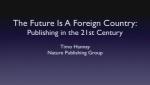
The Future is a Foreign Country
Abstract:
Date: 09/09/2008 - 10:00 am
Reference:
Speaker comments:
Tech Note:
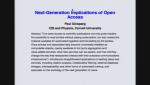
Next-Generation Implications of Open Access
Abstract: True open access to scientific publications not only gives readers the possibility to read articles without paying subscription, but also makes the material available for automated ingestion and harvesting by 3rd parties. Once articles and associated data become universally treatable as computable ...
read more
Date: 09/09/2008 - 11:00 am
Reference:
Speaker comments:
Tech Note:
21st Century Science Maps
Abstract: Cartographic maps of physical places have guided mankind's explorations for centuries. They enabled the discovery of new worlds while also marking territories inhabited by unknown monsters. Domain maps of abstract semantic spaces, see scimaps.org, aim to serve today's explorers understanding and nav...
read more
Date: 09/09/2008 - 2:00 pm
Reference:
Speaker comments:
Tech Note:
The evolution of scholarly communication and the supreme power of inertia
Abstract: The rapid technological change around us supports the idea of general speedup in the tempo of life, the illusion that we are living 'on Internet time.' Yet many changes are still taking generations, and that includes changes in scientific communication as well as in sociology of science. The evidenc...
read more
Date: 09/09/2008 - 3:30 pm
Reference:
Speaker comments:
Tech Note:
The Wiki: An Environment for Scholarly Conversation and Publishing (IT tools for Science)
Abstract: 'The Medium Is The Message ... The Audience Is The Content', Marshall McLuhan, Understanding Media: The Extensions of Man, New York: McGraw-Hill, 1964. A 'wiki is a ... collaborative space ... because of its total freedom, ease of access, and use, [and] simple and uniform navigational conventions .....
read more
Date: 09/09/2008 - 6:00 pm
Reference:
Speaker comments:
Tech Note:
Physics Wiki (IT tools for Science)
Abstract: A wiki is an excellent tool for organizing and representing human knowledge. By building a personal wiki notebook, a scientific researcher may optimally organize past and current research notes. In this brief practical introduction I will provide a guided tour of an open scientific notebook -- physi...
read more
Date: 09/09/2008 - 6:20 pm
Reference:
Speaker comments:
Tech Note:
Mendeley: A Last.fm for Research? (IT tools for Science)
Abstract: Mendeley is a new 'science 2.0' tool for managing & sharing academic papers. Its co-founder, Victor Henning, will highlight conceptual similarities between Last.fm and Mendeley to explore whether the ideas behind social music services can be applied to social software for researchers.
Date: 09/09/2008 - 6:40 pm
Reference:
Speaker comments:
Tech Note:
Does electronic communication make any difference to the nature of expertise?
Abstract: I introduce `The Periodic Table of Expertises' (Collins and Evans 2007). The classification is driven by the idea of tacit knowledge. Its most important division is between the expertise of those who have acquired tacit knowledge pertaining to a specialism as a result of social interaction with the ...
read more
Date: 10/09/2008 - 10:00 am
Reference:
Speaker comments:
Tech Note:
Toil, Trouble, and the Cold War Bubble: Physics and the Academy since World War II
Abstract: In the wake of recent swings in the values of technology stocks and the prices of real estate, many people have become (painfully) familiar with the boom-and-bust cycles of speculative bubbles. Although playing out on longer time-scales, student enrollments in the sciences have followed a remarkably...
read more
Date: 10/09/2008 - 2:00 pm
Reference:
Speaker comments:
Tech Note:
Science as an ethical community
Abstract: I develop the idea that science works because scientists form communities defined by a set of ethical principles which, even if imperfectly applied, tend to lead to progress in our understanding of nature. While these communities have long been international, the combination of the internet with che...
read more
Date: 10/09/2008 - 3:30 pm
Reference:
Speaker comments:
Tech Note:
Designing Digital Institutions: Science in Government 2.0
Abstract: The current paradigm for decision-making is government is beset by instances of ideological bias and manipulation. The Bush-Cheney Administration, which imposed ideological litmus testing on scientific advisors, eliminated advisory panels, and selectively edited reports on environmental hazards and...
read more
Date: 11/09/2008 - 10:00 am
Reference:
Speaker comments:
Tech Note:
Sheldon Glashow Owes me a Dollar (and 17 years of interest): What happens in the marketplace of ideas when the endless frontier meets the efficient frontier?
Abstract: The emergence of novel funding structures in science may be seen as paralleling developments in financial engineering over the past 25 years. In this comparison, entities like FQXi, Perimeter Institute, CMI, Howard Hughes, the Gates Foundation and other funding agencies are emerging as 'intellectua...
read more
Date: 11/09/2008 - 11:00 am
Reference:
Speaker comments:
Tech Note:
Networked Individualism and the Triple Revolution: Networks, Internet and Mobility
Abstract: Three revolutions are coming together to shift people's social lives away from tight-knit family and neighborhood relationships towards more far-flung, less tight, more diverse personal networks. The internet revolution, the mobile revolution, and the social network revolution are producing a new so...
read more
Date: 11/09/2008 - 2:00 pm
Reference:
Speaker comments:
Tech Note:
Cultural openness and its connection to online innovation in science
Abstract: How can we best take advantage of the internet to improve how science is done? Much attention has been paid to open access and open data as enablers of online innovation. In this talk, I discuss the complementary issue of cultural openness in science, and argue that a relatively closed culture is in...
read more
Date: 11/09/2008 - 3:30 pm
Reference:
Speaker comments:
Tech Note:
Can the Web Make Scientists Brush Their Teeth?
Abstract: Computation is increasingly important in all branches of science, but most scientists have no idea how reliable their software is, and cannot reproduce even their own computational results if more than a few weeks have passed. 'Live on the web' labs and other new ideas promise to change this, but fa...
read more
Date: 12/09/2008 - 10:00 am
Reference:
Speaker comments:
Tech Note:
Science in the open /or/ How I learned to stop worrying and love my blog
Abstract: The idea behind the 'Open Science Movement' is that by making data, results, and protocols freely available to the research community for use and re-use a step change in the efficiency of carrying out science can be achieved. In this talk I will discuss the experience of my research group in pursuin...
read more
Date: 12/09/2008 - 11:00 am
Reference:
Speaker comments:
Tech Note: