


Format results
-

Clifford Johnson: University of Southern California
Clifford Johnson - University of California, Santa Barbara
-
Phiala Shanahan: MIT
Phiala Shanahan - Massachusetts Institute of Technology (MIT) - Department of Physics
-

Jocelyn Bell Burnell: University of Oxford
Jocelyn Bell Burnell - University of Oxford
-
Avery Broderick: Perimeter Institute and University of Waterloo
Avery Broderick - University of Waterloo
-
Roger Melko: Perimeter Institute and University of Waterloo
Roger Melko - University of Waterloo
-
Rob Moore: Stanford Institute for Materials and Energy Sciences
Rob Moore - Stanford University
-
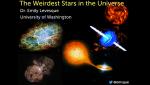
Emily Levesque: The Weirdest Stars in the Universe
Emily Levesque - University of Washington
-

Robert Spekkens: The riddle of the quantum sphinx: quantum states and category mistakes
Robert Spekkens - Perimeter Institute for Theoretical Physics
-

-
Erik Verlinde: A new view on gravity and the dark side of the cosmos
Erik Verlinde - Universiteit van Amsterdam
-
-

Janna Levin: Black Hole Blues and Other Songs from Outer Space
Janna Levin - Columbia University
-
Clifford Johnson: University of Southern California
Clifford Johnson - University of California, Santa Barbara
Clifford V. Johnson is a theoretical physicist passionate about sharing science with the public. He resolved to write a book explaining physics to a lay audience, but he felt that words on a printed page did not fully convey the dynamic, collaborative nature of fundamental research. What if, he… -
Phiala Shanahan: MIT
Phiala Shanahan - Massachusetts Institute of Technology (MIT) - Department of Physics
More than 99% of the visible matter in the universe is built from protons and neutrons and the nuclei that they form. This rich structure emerges dynamically from the complex interactions of quarks and gluons, the most elementary particles that have been discovered. Understanding how nuclear physics… -
Jocelyn Bell Burnell: University of Oxford
Jocelyn Bell Burnell - University of Oxford
Jocelyn Bell Burnell, winner of the 2018 Special Breakthrough Prize in Fundamental Physics, is an accomplished scientist and champion for women in physics. As a graduate student in 1967, she co-discovered pulsars, a breakthrough widely considered one of the most important scientific advances of the… -
Avery Broderick: Perimeter Institute and University of Waterloo
Avery Broderick - University of Waterloo
Dr. Avery Broderick will provide a highly accessible and interesting lecture on the Event Horizon Telescope (EHT) and international efforts to interpret horizon-resolving images of numerous supermassive black holes. Black holes are among the most powerful and mysterious phenomena in the universe… -
Roger Melko: Perimeter Institute and University of Waterloo
Roger Melko - University of Waterloo
Can computers think? They can certainly calculate - with staggering speed and ever-increasing power - and they have driven scientific and technological advances that would have been impossible without them. Even so, we would like to believe that, for some puzzles, there's no substitute for old… -
Rob Moore: Stanford Institute for Materials and Energy Sciences
Rob Moore - Stanford University
From the Stone Age to the Silicon Age, nothing has had a more profound influence on the world than our understanding of the materials around us. The Industrial Revolution of the 19th century and the Information Revolution of the 20th were fueled by humankind’s ability to understand, harness, and… -
Emily Levesque: The Weirdest Stars in the Universe
Emily Levesque - University of Washington
How big can a star get? Why would a star only pretend to explode? Can you hide one star inside another? Take a tour of some of the strangest stellar phenomena in the universe during this talk featuring Emily Levesque. From the biggest, brightest, and most volatile stars to the explosive fireworks of… -
Robert Spekkens: The riddle of the quantum sphinx: quantum states and category mistakes
Robert Spekkens - Perimeter Institute for Theoretical Physics
Science is like puzzle-solving. Making sense of quantum theory is a particularly thorny kind of brain-twister, with more than its fair share of mysteries. If you are stuck on a puzzle, it may be because you have made a false assumption about the nature of some entity that is absolutely central to… -
Pauline Gagnon: Improbable Feats and Useless Discoveries
As a child, Quebec native Pauline Gagnon dreamed of understanding what the universe was really made of. As an adult, she studied exactly that, working at the largest experiment ever built, CERN’s Large Hadron Collider. In her role as a Senior Research Scientist, based at Indiana University and… -
Erik Verlinde: A new view on gravity and the dark side of the cosmos
Erik Verlinde - Universiteit van Amsterdam
Are we standing on the brink of a new scientific revolution that will radically change our views on space, time, and gravity? In most circumstances, the theories of Einstein and Newton adequately describe gravity, but on cosmological scales, big questions arise, particularly surrounding the nature… -
THE TRUTH IS IN THE STARS, a Star Trek Documentary
Join the original Captain Kirk, William Shatner, as he interviews renowned scientists and celebrities about the enduring influence of Star Trek on popular culture, innovation, and creativity. THE TRUTH IS IN THE STARS chronicles Shatner’s journey around the world to discover how Star Trek’s… -
Janna Levin: Black Hole Blues and Other Songs from Outer Space
Janna Levin - Columbia University
More than a billion years ago, two black holes collided. In the final second of their long life together, the black holes banged out a rhythm like mallets on a drum, creating gravitational waves – ripples in the shape of spacetime. One hundred years ago, Albert Einstein predicted the existence of…