


Format results
-

New Foundations for Quantum Statistical Mechanics
Dorje Brody - Imperial College London
-
What if Quantum Thermodynamics were a fundamental extension of Quantum Mechanics?
gian paolo beretta - University of Brescia
-
d=3 SIC POVMs and Elliptic Curves
Lane Hughston - Imperial College London
-

Sicmubbery and the Geometry of Quantum State Space
Marcus Appleby - Queen Mary University of London
-
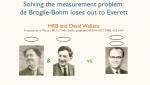
Solving the Measurement Problem: de Broglie-Bohm Loses Out to Everett
Harvey Brown - University of Oxford
-
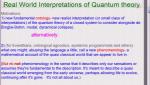
Real world interpretations of Quantum Theory
Adrian Kent - University of Cambridge
-
Decoherence, Entanglement and the Foundation of Quantum Mechanics
Gregg Jaeger - Boston University
-

An Information-Theoretic Approach to Quantum Theory
Philip Goyal - State University of New York (SUNY)
-
-

-
-
-
New Foundations for Quantum Statistical Mechanics
Dorje Brody - Imperial College London
A new microcanonical equilibrium state is introduced for quantum systems with finite-dimensional state spaces. Equilibrium is characterised by a uniform distribution on a level surface of the expectation value of the Hamiltonian. The distinguishing feature of the proposed equilibrium state is that… -
What if Quantum Thermodynamics were a fundamental extension of Quantum Mechanics?
gian paolo beretta - University of Brescia
What if the second law of thermodynamics, in the hierarchy of physical laws, were at the same level as the fundamental laws of mechanics, such as the great conservation principles? What if entropy were an intrinsic property of matter at the same level as energy is universally understood to be? What… -
d=3 SIC POVMs and Elliptic Curves
Lane Hughston - Imperial College London
The simplest algebraic curves of genus one are the nonsingular cubics in two-dimensional complex projective space. Interpreting CP^2 as the space of pure quantum states associated with a Hilbert space of dimension three, I will show how various properties of d=3 symmetric informationally complete… -
Sicmubbery and the Geometry of Quantum State Space
Marcus Appleby - Queen Mary University of London
The solution of many problems in quantum information is critically dependent on the geometry of the space of density matrices. For a Hilbert space of dimension 2 this geometry is very simple: it is simply a sphere. However for Hilbert spaces of dimension greater than 2 the geometry is much more… -
Solving the Measurement Problem: de Broglie-Bohm Loses Out to Everett
Harvey Brown - University of Oxford
-
-
Decoherence, Entanglement and the Foundation of Quantum Mechanics
Gregg Jaeger - Boston University
Results in decoherence theory and entanglement theory will be considered as tools illuminating the foundation of quantum mechanics and the possible relationship of quantum information to it. -
An Information-Theoretic Approach to Quantum Theory
Philip Goyal - State University of New York (SUNY)
The mathematical formalism of quantum theory has many features whose physical origin remains obscure. In this paper, we attempt to systematically investigate the possibility that the concept of information may play a key role in understanding some of these features. We formulate a set of assumptions… -
Recent developments in collapse models
Collapse models are one of the most promising attempts to overcome the measurement problem of quanum mechanics: they descibe, within one single framework, both the quantum properties of microscopic systems and the classical properties of macroscopic objects, and in particular they explain why… -
A Bayesian analysis of quantum theory and tentative generalizations
We will postulate a novel notion of probability; this will involve introducing an extra axiom of probability that seems natural from a Bayesian perspective. We will then provide an analogue of Gleason's theorem for these probabilities. We will also discuss why this approach may be useful for… -
Bohm-Bell beables for quantum field theory
The problem of associating beables (hidden variables) to QFT, in the spirit of what Bohm did for nonrelativistic QM, is not trivial. In 1984, John Bell suggested a way of solving the problem, according to which the beables are the positions of fermions, in a discretized version of QFT, and obey a… -
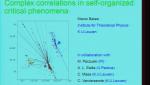
Complex Correlations in Self-Organized Critical Phenomena
Natural critical phenomena are characterized by laminar periods separated by events where bursts of activity take place, and by the interrelated self-similarity of space-time scales and of the event sizes. One example are earthquakes: for this case a new approach to quantify correlations between…