


Format results
-

Causality and positivity in causally complex operational probabilistic theories
Lucien Hardy - Perimeter Institute for Theoretical Physics
-
Quantum Prison Break and the Infinitesimal Limit of Quantum Teleportation
Barbara Soda - Perimeter Institute for Theoretical Physics
-
A theory of Inaccessible Information
Jacopo Surace - Aix-Marseille University
-

-
-
Higher-order transformations and the causal structure of quantum processes
Hlér Kristjánsson - Université de Montréal
-

Correlations, representations and transformers in physics and in AI
Achim Kempf - University of Waterloo
-
-
Commuting operations factorise
Renato Renner - ETH Zurich
-
Single-copy activation of Bell nonlocality and entanglement certification via broadcasting of quantum states
Emanuel-Cristian Boghiu - Institute of Photonic Sciences (ICFO)
-
Quantum influences and event relativity
Nicholas Ormrod - Perimeter Institute for Theoretical Physics
-
-
Causality and positivity in causally complex operational probabilistic theories
Lucien Hardy - Perimeter Institute for Theoretical Physics
In the usual operational picture, operations are represented by boxes having inputs and outputs. Further, we usually consider the causally simple case where the inputs are prior to the outputs for each such operation. In this talk (motivated by an attempt to formulate an operational probabilistic… -
Quantum Prison Break and the Infinitesimal Limit of Quantum Teleportation
Barbara Soda - Perimeter Institute for Theoretical Physics
We will present a teleportation protocol which uses the properties of superoscillatory wavefunctions. Then we will briefly introduce a different protocol, the port based teleportation. We will use it to study teleportation over infinitesimally small distances, where the vacuum of a quantum field… -
A theory of Inaccessible Information
Jacopo Surace - Aix-Marseille University
Out of the many lessons quantum mechanics seems to teach us, one is that it seems there are things we cannot experimentally have access to. There is, indeed, a fundamental limit to our ability to experimentally explore the world. In this work we accept this lesson as a fact and we build a general… -
Universal, deterministic, and exact protocol to reverse qubit-unitary and qubit-encoding isometry operations
Satoshi Yoshida - University of Tokyo
We report a deterministic and exact protocol to reverse any unknown qubit-unitary and qubit-encoding isometry operations. To avoid known no-go results on universal deterministic exact unitary inversion, we consider the most general class of protocols transforming unknown unitary operations within… -
Hamiltonian supermaps: Higher-order quantum transformations of unknown Hamiltonian dynamics
Mio Murao - University of Tokyo
Supermaps are higher-order transformations taking maps as input. We consider quantum algorithms implementing supermaps for the input given by unknown Hamiltonian dynamics, which can be regarded as infinitely divisible unitary operations. We first show a quantum algorithm that approximately but… -
Higher-order transformations and the causal structure of quantum processes
Hlér Kristjánsson - Université de Montréal
In this informal talk, I shall give a short introduction to the field of higher-order quantum transformations, including its subfield of indefinite causal order. I shall discuss some of the motivations and important results in the field, current research directions and open problems, as well… -
Correlations, representations and transformers in physics and in AI
Achim Kempf - University of Waterloo
I will begin by reviewing the general mathematical concept of representation. I will then show that representation theory is more generally applicable than one might expect, for example in quantum foundations, in quantum gravity and in machine learning. In those contexts, I will first talk about the… -
One Hundred Years After Heisenberg: Discovering the World of Simultaneous Measurements of Noncommuting Observables
One hundred years after Heisenberg’s Uncertainty Principle, the question of how to make simultaneous measurements of noncommuting observables lingers. I will survey one hundred years of measurement theory, which brings us to the point where we can formulate how to measure any set observables weakly… -
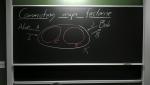
Commuting operations factorise
Renato Renner - ETH Zurich
Tsirelson’s problem involves two agents, Alice and Bob, who apply measurements on the same quantum system, K. It asks whether commutation, i.e., independence of whether Alice or Bob measures first, is sufficient to conclude that Alice and Bob’s measurements can be factorised so that they act non… -
Single-copy activation of Bell nonlocality and entanglement certification via broadcasting of quantum states
Emanuel-Cristian Boghiu - Institute of Photonic Sciences (ICFO)
Activation of Bell nonlocality refers to the phenomenon where some entangled mixed states that admit a local hidden variable model in the standard Bell scenario nevertheless reveal their nonlocal nature in more exotic measurement scenarios. It has recently been shown that by broadcasting the… -
Quantum influences and event relativity
Nicholas Ormrod - Perimeter Institute for Theoretical Physics
A number of no-go theorems suggest that theories upholding both unitarity and relativity must deny that events are absolute. I'll show how quantum causal influences allow us to articulate an attractive conception of relational events. This will lead us towards a precise, observer-independent… -
From quantum picturalism to quantum NLP and quantum AI
Bob Coecke - Quantinuum
In 2020 our Oxford-based Quantinuum team performed Quantum Natural Language Processing (QNLP) on IBM quantum hardware [1, 2]. Key to having been able to achieve what is conceived as a heavily data-driven task, is the observation that quantum theory and natural language are governed by much of the…