


1 - 12 of 18069 Results
Format results
-

TBA - Quantum Information Seminar
Lauritz van Luijk - Leibniz University Hannover

Lecture - Relativity (Core), PHYS 604
Ghazal Geshnizjani - Perimeter Institute for Theoretical Physics

Lecture - Tropical QFT
Michael Borinsky - Perimeter Institute for Theoretical Physics

Lecture - Quantum Field Theory I
Gang Xu - Perimeter Institute for Theoretical Physics

Gravitational scattering off compact objects and the sum over partial waves
Anna Wolz - University of California, Los Angeles

Astrophysical Axions and the Many Ways to Catch Them
Orion Ning - University of California, Berkeley

Instructor Discussion - Beautiful Papers
Pedro Vieira - Perimeter Institute for Theoretical Physics

From Galaxy Catalogs to the Initial Conditions: Building a Digital Twin of the Nearby Universe
Guilhem Lavaux - Institut d'Astrophysique de Paris

Lecture - Tropical QFT
Michael Borinsky - Perimeter Institute for Theoretical Physics

Lecture - Relativity (Core), PHYS 604
Ghazal Geshnizjani - Perimeter Institute for Theoretical Physics

Lecture - Tropical QFT
Michael Borinsky - Perimeter Institute for Theoretical Physics
Entanglement structure of current driven diffusive fermion systems
Michael Gullans - University of Maryland, College Park
Applying a chemical potential bias to a conductor drives the system out of equilibrium into a current carrying non-equilibrium state. This current flow is associated with entropy production in the leads, but it remains poorly understood under what conditions the system is driven to local equilibrium…
Macroscopic Effects of the Quantum Conformal Anomaly: Scalar Gravitational Waves, Black Holes, and Dark Energy
Emil Mottola - Los Alamos National Laboratory
In the second lecture, I will extend the previous discussion to gravity, and show that the conformal trace anomaly must play a special role in the effective field theory of low energy gravity. Classical General Relativity receives an infrared relevant modification from the conformal trace anomaly of…
PSI 2018/2019 - Quantum Field Theory I - Lecture 6
Dan Wohns - Perimeter Institute for Theoretical Physics
Feynman Diagrams
The role of entropy in topological quantum error correction
Michael Beverland - Microsoft Corporation
Ubiquitous in the behavior of physical systems is the competition between an energy term E and an entropy term S of their free energy F = E - beta S. These concepts are also relevant for error correction, where the `energy` E is the number of qubits afflicted by an error, the `entropy' S(E) is the…
Nuclear physics from the Standard Model
Phiala Shanahan - Massachusetts Institute of Technology (MIT) - Department of Physics
I will discuss the status and future of numerical lattice Quantum Chromodynamics (QCD) calculations for nuclear physics. With advances in supercomputing, we are beginning to quantitatively understand nuclear structure and interactions directly from the fundamental quark and gluon degrees of freedom…
Renormalization and Effective Field Theory - Lecture 5
Kevin Costello - Perimeter Institute for Theoretical Physics
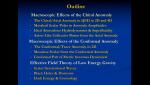
Macroscopic Effects of Quantum Anomalies
Emil Mottola - Los Alamos National Laboratory
In this first of two lectures, intended to be a pedagogical introduction, I will review the quantum field theory origin of anomalies starting with the more familiar example of the axial anomaly in QED, emphasizing the infrared effects and the appearance of a two-particle massless state, similar to a…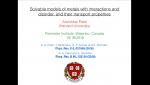
Solvable models of correlated metals with interactions and disorder, and their transport properties
Aavishkar Patel - University of California, Berkeley
Despite much theoretical effort, there is no complete theory of the “strange” metal phase of the high temperature superconductors, and its linear-in-temperature resistivity. This phase is believed to be a strongly-interacting metallic phase of matter without fermionic quasiparticles, and is…
Self-testing of quantum systems
Jędrzej Kaniewski - Center for Theoretical Physics of the Polish Academy of Sciences
Violations of Bell inequalities have traditionally been used to refute a local-realistic description of the world. Not surprisingly, under the assumption that the world is quantum, they can be used to certify quantum devices. What is surprising is that in some cases this characterisation turns out…
Probing dark matter substructures with cold stellar streams
Nilanjan Banik - Leiden University
A key prediction of the Lambda CDM framework of structure formation is that a host halo containing a Milky Way sized disk galaxy should contain hundreds of thousands of sub-dwarf galaxy mass dark matter subhalos. Devoid of stars, these substructures remain undetected. Detecting them will not only…