Format results
-
Circuit-to-Hamiltonian from tensor networks and fault tolerance
Quynh Nguyen - Harvard University
-
Randomly Monitored Quantum Codes
Dongjin Lee - Perimeter Institute for Theoretical Physics
-
Reducing the overhead of quantum error correction
Aleksander Kubica - Yale University
-
-
Hardware-efficient quantum computing using qudits
Christine Muschik - Institute for Quantum Computing (IQC)
-
Concatenate codes, save qubits
Hayata Yamasaki - University of Tokyo
-
An Efficient Quantum Algorithm for Port-based Teleportation
Jiani Fei - Stanford University , Sydney Timmerman - Stanford University
-
Heisenberg-Limited Quantum Metrology without Ancilla (VIRTUAL)
Qiushi Liu - University of Hong Kong (HKU)
-
How fast can one route quantum states
Chao Yin - University of Colorado Boulder
-
Towards preparation of scattering wave packets of hadrons on a quantum computer
Saurabh Kadam - University of Washington
-
Quantum Advantages in Energy Minimization - VIRTUAL ONLY
Leo Zhou - California Institute of Technology (Caltech)
-
Every quantum helps: Operational advantage of quantum resources beyond convexity
Kohdai Kuroiwa - Perimeter Institute for Theoretical Physics
-
Circuit-to-Hamiltonian from tensor networks and fault tolerance
Quynh Nguyen - Harvard University
We define a map from an arbitrary quantum circuit to a local Hamiltonian whose ground state encodes the quantum computation. All previous maps relied on the Feynman-Kitaev construction, which introduces an ancillary ‘clock register’ to track the computational steps. Our construction, on the other… -
Randomly Monitored Quantum Codes
Dongjin Lee - Perimeter Institute for Theoretical Physics
Quantum measurement has conventionally been regarded as the final step in quantum information processing, which is essential for reading out the processed information but collapses the quantum state into a classical state. However, recent studies have shown that quantum measurement itself can induce… -
Reducing the overhead of quantum error correction
Aleksander Kubica - Yale University
Fault-tolerant protocols and quantum error correction (QEC) are essential to building reliable quantum computers from imperfect components that are vulnerable to errors. Optimizing the resource and time overheads needed to implement QEC is one of the most pressing challenges that will facilitate a… -
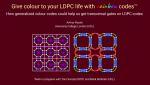
Quantum rainbow codes
With the recent construction of quantum low-density parity-check (LDPC) codes with optimal asymptotic parameters, finding methods to perform low-overhead computation using those constructions has become a central problem of quantum error-correction. In particular, triorthogonal codes---which admit… -
Hardware-efficient quantum computing using qudits
Christine Muschik - Institute for Quantum Computing (IQC)
Particle physics underpins our understanding of the world at a fundamental level by describing the interplay of matter and forces through gauge theories. Yet, despite their unmatched success, the intrinsic quantum mechanical nature of gauge theories makes important problem classes notoriously… -
Concatenate codes, save qubits
Hayata Yamasaki - University of Tokyo
The essential requirement for fault-tolerant quantum computation (FTQC) is the total protocol design to achieve a fair balance of all the critical factors relevant to its practical realization, such as the space overhead, the threshold, and the modularity. A major obstacle in realizing FTQC with… -
An Efficient Quantum Algorithm for Port-based Teleportation
Jiani Fei - Stanford University , Sydney Timmerman - Stanford University
In this talk, we will outline an efficient algorithm for port-based teleportation, a unitarily equivariant version of teleportation useful for constructing programmable quantum processors and performing instantaneous nonlocal computation (NLQC). The latter connection is important in AdS/CFT, where… -
Heisenberg-Limited Quantum Metrology without Ancilla (VIRTUAL)
Qiushi Liu - University of Hong Kong (HKU)
The asymptotic theory of quantum channel estimation has been well established, but in general noiseless and controllable ancilla is required for attaining the ultimate limit in the asymptotic regime. Little is known about the metrological performance without noiseless ancilla, which is more relevant… -
How fast can one route quantum states
Chao Yin - University of Colorado Boulder
Many quantum platforms naturally host Hamiltonians with power-law or even all-to-all connectivity, which may potentially process quantum information in a way much faster than conventional gate-based models. For such non-geometrically-local Hamiltonians, it is then important to both come up with fast… -
Towards preparation of scattering wave packets of hadrons on a quantum computer
Saurabh Kadam - University of Washington
Hamiltonian simulation of lattice gauge theories (LGTs) is a non-perturbative method of numerically solving gauge theories that offers novel avenues for studying scattering processes in gauge theories. With the advent of quantum computers, Hamiltonian simulation of LGTs has become a reality… -
Quantum Advantages in Energy Minimization - VIRTUAL ONLY
Leo Zhou - California Institute of Technology (Caltech)
Minimizing the energy of a many-body system is a fundamental problem in many fields. Although we hope a quantum computer can help us solve this problem better than classical computers, we have a very limited understanding of where a quantum advantage may be found. In this talk, I will present some… -
Every quantum helps: Operational advantage of quantum resources beyond convexity
Kohdai Kuroiwa - Perimeter Institute for Theoretical Physics
As quantum technologies are expected to provide us with unprecedented benefits, identifying what quantum-mechanical properties are useful is a pivotal question. Quantum resource theories provide a unified framework to analyze such quantum properties, which has been successful in the understanding of…