Singular gauges and dS invariance of the graviton vacuum
Donald Marolf - University of California, Santa Barbara


Hebecker, A. (2010). Inflationary Correlation Functions without Infrared Divergences. Perimeter Institute. https://pirsa.org/10100064
Hebecker, Arthur. Inflationary Correlation Functions without Infrared Divergences. Perimeter Institute, Oct. 27, 2010, https://pirsa.org/10100064
@misc{ pirsa_PIRSA:10100064,
  doi = {10.48660/10100064},
  url = {https://pirsa.org/10100064},
  author = {Hebecker, Arthur},
  keywords = {Cosmology},
  language = {en},
  title = {Inflationary Correlation Functions without Infrared Divergences},
  publisher = {Perimeter Institute},
  year = {2010},
  month = {oct},
  note = {PIRSA:10100064 see, \url{https://pirsa.org}}
}
Donald Marolf - University of California, Santa Barbara

Steven Weinberg - University of Texas - Austin
Martin Sloth - University of Southern Denmark
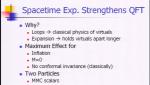
Richard Woodard - University of Florida
Yuko Urakawa - Waseda University
Sarah Shandera - Pennsylvania State University