Format results
-
New Horizons in Cosmology: The Trace Anomaly, Cosmological Horizon Modes and Dynamical Dark Energy
Emil Mottola - Los Alamos National Laboratory
-
IR divergence problem in single-field models of inflation
Yuko Urakawa - Waseda University
-
Resumming late time divergences and comparing thermal vs dS
Louis Leblond - Pennsylvania State University
-
The problems of quantum gravity: from high-energy scattering to black holes and cosmology
Steve Giddings - University of California, Santa Barbara
-
The Feynman Propagator and Correlation Functions in an Inflating Spacetime
Jason Kumar - University of Hawaii at Manoa
-
Inflationary Correlation Functions without Infrared Divergences
Arthur Hebecker - Universität Heidelberg
-
Singular gauges and dS invariance of the graviton vacuum
Donald Marolf - University of California, Santa Barbara
-
Infrared sensitivity of unstable vacua
Alexander Polyakov - Princeton University
-
Particle decay in the de Sitter universe
Ugo Moschella - University of Insubria
-
-
One-loop Riemann correlators and dS invariance
Albert Roura - Universität Ulm
-
Unitarity and vacuum decay
Jose Roberto Vidal - Universidad Autonoma de Madrid
-
New Horizons in Cosmology: The Trace Anomaly, Cosmological Horizon Modes and Dynamical Dark Energy
Emil Mottola - Los Alamos National Laboratory
General Relativity receives quantum corrections relevant at macroscopic distance scales and near event horizons. These arise from the conformal scalar degrees of freedom in the extended effective field theory of gravity generated by the trace anomaly of massless quantum fields in curved space… -
IR divergence problem in single-field models of inflation
Yuko Urakawa - Waseda University
We clarify the origin of IR divergence in single-field models of inflation and provide the correct way to calculate the observable fluctuations. First, we show the presence of gauge degrees of freedom in the frequently used gauges such as the comoving gauge and the flat gauge. These gauge degrees of… -
Resumming late time divergences and comparing thermal vs dS
Louis Leblond - Pennsylvania State University
I will argue that the dynamical renormalization group can be used to resum late time divergences appearing in loop computations in de Sitter. In the case of a scalar field with quartic interactions, the resummed propagator is the massive one. Standard mean field theory techniques can then be used to… -
The problems of quantum gravity: from high-energy scattering to black holes and cosmology
Steve Giddings - University of California, Santa Barbara
Much work on quantum gravity has focussed on short-distance problems such as non-renormalizability and singularities. However, quantization of gravity raises important long-distance issues, which may be more important guides to the conceptual advances required. These include the problems of black… -
The Feynman Propagator and Correlation Functions in an Inflating Spacetime
Jason Kumar - University of Hawaii at Manoa
We discuss the definition of the Feynman propagator in de Sitter space. We show that the ambiguities in the propagator zero-mode can be used to make sense of the behavior of low-momentum modes in an inflating space-time. We use this tool to calculate loop corrections to non-Gaussian correlation… -
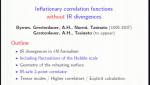
Inflationary Correlation Functions without Infrared Divergences
Arthur Hebecker - Universität Heidelberg
The definition of correlation functions relies on measuring distances on some late surface of equal energy density. If invariant distances are used, the curvature correlation functions of single-field inflation are free of any IR sensitivity. By contrast, conventional correlation functions, defined… -
Singular gauges and dS invariance of the graviton vacuum
Donald Marolf - University of California, Santa Barbara
There has been a long-running discussion as to whether free gravitons on dS have a dS-invariant state. On the one hand, de Sitter invariant states are clearly singular in gauges favored by cosmologists; e.g. transverse traceless synchronous gauge associated with the k=0 slicing of dS. However… -
-
Particle decay in the de Sitter universe
Ugo Moschella - University of Insubria
We study particle decay in the de Sitter spacetime as given by first order perturbation theory in an interacting quantum field theory. We discuss first a general construction of bosonic two-point functions, including a recently discovered class of tachyonic theories that do exist in the de Sitter… -
On the Equivalence between Euclidean and In-In Formalisms in de Sitter QFT
Atsushi Higuchi - University of York
We study the relation between two sets of correlators in interacting quantum field theory on de Sitter space. The first are correlators computed using in-in perturbation theory in the region of de Sitter space to the future of a cosmological horizon (also known as the expanding cosmological patch… -
One-loop Riemann correlators and dS invariance
Albert Roura - Universität Ulm
I will start with a brief qualitative discussion of the construction of a dS-invariant state for interacting theories using Euclidean methods and its real-time evolution within the closed-time-path formalism, as well as of the closely related in-in formalism. Next, I will focus on the two-point… -
Unitarity and vacuum decay
Jose Roberto Vidal - Universidad Autonoma de Madrid
The stability of spacetime has been related to the production of particles and also to the imaginary parts of the perturbative series. The unitarity relations of the quantum theory impose relations between these two phenomena.