Format results
-
Introduction: Science in the 21st Century
Sabine Hossenfelder - Ludwig-Maximilians-Universität München (LMU)
-
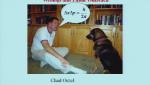
Talking to My Dog about Science: Weblogs and Public Outreach
Chad Orzel - Uncertain Principles
-
Blogs, Wikis, MathML: Scientific Communication
Jacques Distler - The University of Texas at Austin
-
-
The Future is a Foreign Country: Science Publishing in the 21st Century
Timo Hannay - Springer Nature Group
-
Next-Generation Implications of Open Access
Paul Ginsparg - Cornell University
-
-
The evolution of scholarly communication and the supreme power of inertia
Andrew Odlyzko - University of Minnesota
-
-
Physics Wiki (IT tools for Science)
Garrett Lisi - Pacific Science Institute
-
Mendeley: A Last.fm for Research? (IT tools for Science)
Victor Henning - Mendeley (United Kingdom)
-
-
Introduction: Science in the 21st Century
Sabine Hossenfelder - Ludwig-Maximilians-Universität München (LMU)
-
Talking to My Dog about Science: Weblogs and Public Outreach
Chad Orzel - Uncertain Principles
At a time when the great challenges facing our civilization are scientific in nature (climate change, sustainable energy, pandemic disease), improving the voting public\'s understanding and appreciation of science is more important than ever. I will argue that the Internet in general and weblogs… -
Blogs, Wikis, MathML: Scientific Communication
Jacques Distler - The University of Texas at Austin
In the 1990s, the eprint arXivs fundamentally reshaped scientific communication in Math and Physics. In this decade, blogs, wikis and other, similar, tools are mediating an equally profound reshaping of scientific communication. I will talk about my own experience, as a blogger, software designer… -
Open Access Is Public Access
This talk will review the public impact of developments in open access to research on education, professional practice, and public policy, with consideration given to legal, economic, and academic freedom issues, as well as to the very design of scholarly communication systems. The Public Knowledge… -
The Future is a Foreign Country: Science Publishing in the 21st Century
Timo Hannay - Springer Nature Group
The shift from print to online has already created a revolution in scientific communication, but it is far from complete. Among other effects, it has brought huge opportunities and threats to incumbent publishers. This talk will discuss the imperative for publishers to keep moving forward if they… -
Next-Generation Implications of Open Access
Paul Ginsparg - Cornell University
True open access to scientific publications not only gives readers the possibility to read articles without paying subscription, but also makes the material available for automated ingestion and harvesting by 3rd parties. Once articles and associated data become universally treatable as computable… -
21st Century Science Maps
Katy Boerner - Indiana University
Cartographic maps of physical places have guided mankind\'s explorations for centuries. They enabled the discovery of new worlds while also marking territories inhabited by unknown monsters. Domain maps of abstract semantic spaces, see scimaps.org, aim to serve today\'s explorers understanding and… -
The evolution of scholarly communication and the supreme power of inertia
Andrew Odlyzko - University of Minnesota
The rapid technological change around us supports the idea of general speedup in the tempo of life, the illusion that we are living \'on Internet time.\' Yet many changes are still taking generations, and that includes changes in scientific communication as well as in sociology of science. The… -
The Wiki: An Environment for Scholarly Conversation and Publishing (IT tools for Science)
Gerry McKiernan - Iowa State University
\'The Medium Is The Message ... The Audience Is The Content\', Marshall McLuhan, Understanding Media: The Extensions of Man, New York: McGraw-Hill, 1964. A \'wiki is a ... collaborative space ... because of its total freedom, ease of access, and use, [and] simple and uniform navigational conventions… -
Physics Wiki (IT tools for Science)
Garrett Lisi - Pacific Science Institute
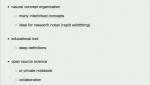
A wiki is an excellent tool for organizing and representing human knowledge. By building a personal wiki notebook, a scientific researcher may optimally organize past and current research notes. In this brief practical introduction I will provide a guided tour of an open scientific notebook --… -
Mendeley: A Last.fm for Research? (IT tools for Science)
Victor Henning - Mendeley (United Kingdom)
Mendeley is a new \'science 2.0\' tool for managing & sharing academic papers. Its co-founder, Victor Henning, will highlight conceptual similarities between Last.fm and Mendeley to explore whether the ideas behind social music services can be applied to social software for researchers. -
Does electronic communication make any difference to the nature of expertise?
Harry Collins - Cardiff University
I introduce `The Periodic Table of Expertises\' (Collins and Evans 2007). The classification is driven by the idea of tacit knowledge. Its most important division is between the expertise of those who have acquired tacit knowledge pertaining to a specialism as a result of social interaction with the…