Format results
-
Opening Welcome
Giulio Chiribella - University of Hong Kong (HKU)
-
Is Information the Key?
Gilles Brassard - Université de Montréal
-
Part 1: Reformulating and reconstructing quantum theory
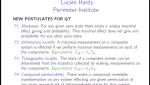
Lucien Hardy - Perimeter Institute for Theoretical Physics
-

Quantum Theory as a Theory of Information Processing
Paolo Perinotti - University of Pavia
-
Entanglement and the three-dimensionality of the Bloch sphere
Lluis Masanes - University College London
-
From operational axioms to quantum theory - and beyond?
Markus Müller - Austrian Academy of Sciences
-
On Basic Principles of General Probabilistic Theories
Gen Kimura - National Institute of Advanced Industrial Science and Technology
-
-
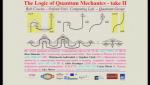
The logic of quantum mechanics - take II
Bob Coecke - Quantinuum
-
Symmetry, Self-Duality and the Jordan Structure of Quantum Theory
Alexander Wilce - Susquehanna University
-
Some Negative Remarks on Operational Approaches to Quantum Theory
Chris Fuchs - University of Massachusetts Boston
-
Quantum correlations with no causal order
Časlav Brukner - Austrian Academy of Sciences
-
-
Is Information the Key?
Gilles Brassard - Université de Montréal
Consider the two great physical theories of the twentieth century: relativity and quantum mechanics. Einstein derived relativity from very simple principles. By contrast, the foundation of quantum mechanics is built on a set of rather strange, disjointed and ad hoc axioms, reflecting at best the… -
Part 1: Reformulating and reconstructing quantum theory
Lucien Hardy - Perimeter Institute for Theoretical Physics
I provide a reformulation of finite dimensional quantum theory in the circuit framework in terms of mathematical axioms, and a reconstruction of quantum theory from operational postulates. The mathematical axioms for quantum theory are the following: [Axiom 1] Operations correspond to operators.… -
Quantum Theory as a Theory of Information Processing
Paolo Perinotti - University of Pavia
Quantum Theory can be derived from six operational axioms. We introduce the operational and probabilistic language that is used to formulate the principles. After the basic notions of system, state, effect and transformation are reviewed, the principles are stated, and their immediate consequences… -
Entanglement and the three-dimensionality of the Bloch sphere
Lluis Masanes - University College London
We consider theories that satisfy: information causality, reversibility, local discriminability, all tight effects are measurable. A property of these theories is that binary systems (with two perfectly distinguishable states and no more) have state spaces with the shape of a unit ball (the Bloch… -
From operational axioms to quantum theory - and beyond?
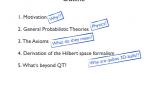
Markus Müller - Austrian Academy of Sciences
Usually, quantum theory (QT) is introduced by giving a list of abstract mathematical postulates, including the Hilbert space formalism and the Born rule. Even though the result is mathematically sound and in perfect agreement with experiment, there remains the question why this formalism is a… -
On Basic Principles of General Probabilistic Theories
Gen Kimura - National Institute of Advanced Industrial Science and Technology
We propose an operationally motivated definition of the physical equivalence of states in General Probabilistic Theories and consider the principle of the physical equivalence of pure states, which turns out to be equivalent to the symmetric structure of the state space. We further consider a… -
Almost quantum theory
Ben Schumacher - Kenyon College
Modal quantum theory (MQT) is a discrete model that is similar in structure to ordinary quantum theory, but based on a finite field instead of complex amplitudes. Its interpretation involves only the "modal" concepts of possibility and impossibility rather than quantitative probabilities. Despite… -
The logic of quantum mechanics - take II
Bob Coecke - Quantinuum
It is now exactly 75 years ago that John von Neumann denounced his own Hilbert space formalism: ``I would like to make a confession which may seem immoral: I do not believe absolutely in Hilbert space no more.'' (sic) [1] His reason was that Hilbert space does not elucidate in any direct manner the… -
Symmetry, Self-Duality and the Jordan Structure of Quantum Theory
Alexander Wilce - Susquehanna University
This talk reviews recent and on-going work, much of it joint with Howard Barnum, on the origins of the Jordan-algebraic structure of finite-dimensional quantum theory. I begin by describing a simple recipe for constructing highly symmetrical probabilistic models, and discuss the ordered linear… -
Some Negative Remarks on Operational Approaches to Quantum Theory
Chris Fuchs - University of Massachusetts Boston
Over the last 10 years there has been an explosion of âÂÂoperational reconstructionsâ of quantum theory. This is great stuff: For, through it, we come to see the myriad ways in which the quantum formalism can be chopped into primitives and, through clever toil, brought back together to form… -
Quantum correlations with no causal order
Časlav Brukner - Austrian Academy of Sciences
Much of the recent progress in understanding quantum theory has been achieved within an operational approach. Within this context quantum mechanics is viewed as a theory for making probabilistic predictions for measurement outcomes following specified preparations. However, thus far some of the…