Format results
-
Neutron Star Mass and Radius Constraints for the Dense Matter Equation of State
James Lattimer - Stony Brook University
-
-
Equation of State and Neutrino Opacity in Core Collapse Supernova
Gang Shen - Los Alamos National Laboratory
-
Three-nucleon forces: From neutron matter to neutron stars
Kai Hebeler - Ohio State University
-
Spin-polarized low-density neutron matter
Alexandros Gezerlis - University of Guelph
-
-
-
Excitation of Neutron Star Modes During Binary
David Tsang - California Institute of Technology
-
-
-
Recent advances in core-collapse supernova theory
Jason Nordhaus - Princeton University
-
Microphysics in Computational Relativistic Astrophysics - Discussion 2
Christian Ott - California Institute of Technology
-
Neutron Star Mass and Radius Constraints for the Dense Matter Equation of State
James Lattimer - Stony Brook University
Recent discoveries, including a 2 solar mass pulsar, rapid cooling in the Cas A supernova remnant, and estimates of masses and radii from photospheric radius expansion bursts and thermal emissions from neutron stars, are able to constrain significantly the properties of dense matter. Implications… -
Relativistic EOS for Supernovae Simulations
We construct the relativistic equation of state (EOS) of dense matter covering a wide range of temperature proton fraction and density for the use of core-collapse supernova simulations. The study is based on the relativistic mean-field (RMF) theory which can provide an excellent description of… -
Equation of State and Neutrino Opacity in Core Collapse Supernova
Gang Shen - Los Alamos National Laboratory
We present new equations of state (EOS) of nuclear matter for a wide range of temperatures densities and proton fractions for use in supernova and neutron star merger simulations. We employ a full relativistic mean field (RMF) calculation for matter at intermediate density and high density and the… -
-
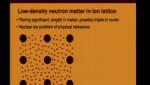
Spin-polarized low-density neutron matter
Alexandros Gezerlis - University of Guelph
Low-density neutron matter is relevant to the study of neutron-rich nuclei and neutron star crusts. Unpolarized neutron matter has been studied extensively over a number of decades, while experimental guidance has recently started to emerge from the field of ultracold atomic gases. We study… -
-
An effective theory for the neutron star inner crust
Rishi Sharma - TRIUMF
The inner crust of neutron stars has a remarkable property that it is crystalline as well as superfluid. I will describe the low energy theory of systems with this property in general, and describe how to relate the low energy constants of the theory to derivatives of the free energy with respect to… -
-
-
Recipes to energize core-collapse supernova explosions
Recent multidimensional supernova simulations seem to support an assumption that the neutrino-driven mechanism might work to blow up massive stars. However the explosion energies obtained in those simulations are usually not enough to account for the canonical explosion energy of 10^51 ergs. In this… -
Recent advances in core-collapse supernova theory
Jason Nordhaus - Princeton University
For approximately half a century, core-collapse supernovae have posed a vexing puzzle for theorists despite being a major ingredient (and uncertainty) in fields ranging from stellar and galaxy evolution to the interstellar medium. Historically, advances in core-collapse theory have been linked to… -
Microphysics in Computational Relativistic Astrophysics - Discussion 2
Christian Ott - California Institute of Technology