Format results
-
Pedagogical Introduction to Tensor Networks: MPS, PEPS and MERA
Guifre Vidal - Alphabet (United States)
-
Simulation of Fermionic and Frustrated Systems with 2D Tensor Networks
Philippe Corboz - Universiteit van Amsterdam
-
Tensor Networks and TQFTs
Zheng-Cheng Gu - Chinese University of Hong Kong
-
-
-
-
-
First Principle Construction of Holographic Duals
Sung-Sik Lee - McMaster University
-
-
-
Pedagogical Introduction to Tensor Networks: MPS, PEPS and MERA
Guifre Vidal - Alphabet (United States)
This introductory talk aims to answer a few basic questions (What is a tensor network? Under which circumstance is a tensor network useful?) and describe the tensor network states that will be discussed during the workshop (matrix product state [MPS], projected entangled pair states [PEPS], and the… -
Simulation of Fermionic and Frustrated Systems with 2D Tensor Networks
Philippe Corboz - Universiteit van Amsterdam
The study of fermionic and frustrated systems in two dimensions is one of the biggest challenges in condensed matter physics. Among the most promising tools to simulate these systems are 2D tensor networks, including projected entangled-pair states (PEPS) and the 2D multi-scale entanglement… -
Tensor Networks and TQFTs
Zheng-Cheng Gu - Chinese University of Hong Kong
In this talk, I will present a first principle construction of a holographic dual for gauged matrix models that include gauge theories. The dual theory is shown to be a closed string field theory coupled with an emergent two-form gauge field defined in one higher dimensional space. The bulk space… -
MPS for QFTs
Frank Verstraete - Ghent University
I will talk about matrix product states and their suitability for simulating quantum many-body systems in the continuum. -
MPS for Relativistic QFTs
Jutho Haegeman - Ghent University
In 1987, Feynman devoted one of his last lectures to highlighting three serious objections against the usefulness of the variational principle in the theory of relativistic quantum fields. In that same year, in a different branch of physics, Affleck, Kennedy, Lieb and Tasaki devised a quantum state… -
Perimeter Institute Pedagogical Introduction: Tensor Networks and Geometry, the Renormalization Group and AdS/CFT
Guifre Vidal - Alphabet (United States)
One might be confused by the proliferation of tensor network states, such as MPS, PEPS, tree tensor networks [TTN], MERA, etc. What is the main difference between them? In this talk I will argue that the geometry of a tensor network determines several properties of the state that is being… -
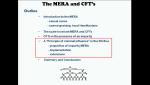
MERA and CFT
Glen Evenbly - Georgia Institute of Technology
The MERA offers a powerful variational approach to quantum field theory. While the continuous MERA may allow us to directly address field theories in the continuum, the MERA on the lattice has already demonstrated its ability to characterize conformal field theories. In this talk I will explain how… -
First Principle Construction of Holographic Duals
Sung-Sik Lee - McMaster University
Topological Quantum field theories(TQFTs) are a special class of QFTs. Their actions do not depend on the metric of the background space-time manifold. Thus, it is very natural to define TQFTs on an arbitrary triangulation of the space-time manifold and they are independent on the triangulation… -
MERA for QFTs
Tobias Osborne - Leibniz University Hannover
In this talk I will describe how to generalize the multiscale entanglement renormalization ansatz to quantum fields. The resulting variational class of wavefunctions, cMERA, arising from this RG flow are translation invariant and exhibit an entropy-area law. I'll illustrate the construction for some… -
MERA for Relativistic QFTs
Jutho Haegeman - Ghent University
In this second presentation, we will revisit Feynman's first argument and discuss how it still strongly influences variational studies of relativistic field theories with MPS or cMPS. However, as we explain, this argument can be completely overcome by introducing different variational parameters for…