Format results
-
-
Aharonov-Bohm effect in symmetry protected states
Luiz Santos - Emory University
-
Emergence of p+ip topological superconducting ground state in infinite-U Hubbard model on honeycomb lattice
Zheng-Cheng Gu - Chinese University of Hong Kong
-
Specific heat and ac susceptibility measurements on the Spin Ice, Dy2Ti2O7
Jan Kycia - University of Waterloo
-
Topological response in gapless systems: from Weyl semimetals to metallic ferromagnets
Anton Burkov - University of Waterloo
-
Tuning magnetism and Chern bands in spin-orbit coupled double perovskites
Arun Paramekanti - University of Toronto
-
-
Geometry of topological matter: some examples
Duncan Haldane - Princeton University
-
-
Geometrical dependence of information in 2d critical systems
Paul Fendley - University of Oxford
-
A symmetry-respecting topologically-ordered surface phase of 3d electron topological insulators.
Max Metlitski - Massachusetts Institute of Technology (MIT) - Department of Physics
-
Quantum Tapestries
Matthew Fisher - University of California, Santa Barbara
-
Topological phases in graphene
Zlatko Papic - University of Leeds
As realized for the first time in 1980s, quantum many-body systems in reduced spatial dimensions can sometimes undergo a special type of ordering which does not break any symmetry but introduces long-range entanglement and emergent excitations that have radically different properties from their… -
Aharonov-Bohm effect in symmetry protected states
Luiz Santos - Emory University
Symmetry protected topological (SPT) states are generalizations of topological band insulators to interacting systems. They possess a gapped bulk spectrum together with symmetry protected edge states, with no topological order. There has been recently an intense effort to classify SPT states both in… -
Emergence of p+ip topological superconducting ground state in infinite-U Hubbard model on honeycomb lattice
Zheng-Cheng Gu - Chinese University of Hong Kong
In this talk, I will show the emergence of p+ip topological superconducting ground state in infinite-U Hubbard model on honeycomb lattice, from both state-of-art Grassmann tensor-network numerical approach and quantum field theory approach. -
Specific heat and ac susceptibility measurements on the Spin Ice, Dy2Ti2O7
Jan Kycia - University of Waterloo
Some time ago (1999), Dy2Ti2O7, was shown to be a magnetic analog of water ice, and thus dubbed "spin ice". Recently, theories and experiments have developed the perspective of viewing excitations within the low temperature phase of this spin ice as monopoles. I will present early results of… -
Topological response in gapless systems: from Weyl semimetals to metallic ferromagnets
Anton Burkov - University of Waterloo
Standard picture of a topologically-nontrivial phase of matter is an insulator with a bulk energy gap, but metallic surface states, protected by the bulk gap. Recent work has shown, however, that certain gapless systems may also be topologically nontrivial, in a precise and experimentally observable… -
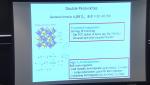
Tuning magnetism and Chern bands in spin-orbit coupled double perovskites
Arun Paramekanti - University of Toronto
We show that double perovskites with 3d and 5d transition metal ions exhibit spin-orbit coupled magnetic excitations, finding good agreement with neutron scattering experiments in bulk powder samples. Motivated by experimental developments in the field of oxide heterostructures, we also study double… -
Fractional Quantum Hall Effect in a curved space
We developed a general method to compute the correlation functions of FQH states on a curved space. The computation features the gravitational trace anomaly and reveals geometric properties of FQHE. Also we highlight a relation between the gravitational and electromagnetic response functions. The… -
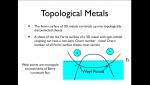
Geometry of topological matter: some examples
Duncan Haldane - Princeton University
I will look at two cases of the interplay of geometry (curvature) and topology: (1) 3D Topological metals: how to understand their surface "Fermi arcs" in terms of their emergent conservation laws and the Streda formula for the non-quantized anomalous Hall effect. (2) The Hall viscosity tensor in… -
Many-body localization: Local integrals of motion, area-law entanglement, and quantum dynamics
Dmitry Abanin - Princeton University
We demonstrate that the many-body localized phase is characterized by the existence of infinitely many local conservation laws. We argue that many-body eigenstates can be obtained from product states by a sequence of nearly local unitary transformation, and therefore have an area-law entanglement… -
Geometrical dependence of information in 2d critical systems
Paul Fendley - University of Oxford
In both classical and quantum critical systems, universal contributions to the mutual information and Renyi entropy depend on geometry. I will first explain how in 2d classical critical systems on a rectangle, the mutual information depends on the central charge in a fashion making its numerical… -
A symmetry-respecting topologically-ordered surface phase of 3d electron topological insulators.
Max Metlitski - Massachusetts Institute of Technology (MIT) - Department of Physics
A 3d electron topological insulator (ETI) is a phase of matter protected by particle-number conservation and time-reversal symmetry. It was previously believed that the surface of an ETI must be gapless unless one of these symmetries is broken. A well-known symmetry-preserving, gapless surface… -
Quantum Tapestries
Matthew Fisher - University of California, Santa Barbara
Within each of nature's crystals is an exotic quantum world of electrons weaving to and fro. Each crystal has it's own unique tapestry, as varied as the crystals themselves. In some crystals, the electrons weave an orderly quilt. Within others, the electrons are seemingly entwined in an entangled…