Format results
-
-
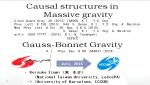
Causal structures in Massive gravity and Gauss-Bonnet gravity
Keisuke Izumi - National Taiwan University
-
-
-
Subluminal Vainshtein Screening in Massive Gravity
Lasha Berezhiani - University of Pennsylvania
-
-
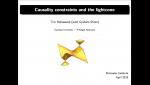
Causality constraints and the lightcone
Timothy Hollowood - Swansea University
-
-
Uncertainty Relations, Classicalization and Superluminal propagation
Alex Vikman - New York University (NYU)
-
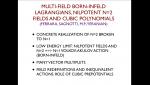
Multi-Field Born-Infeld Lagrangians, Nilpotent Fields, N=2 Supersymmetry and Cubic Polynomials
Massimo Porrati - New York University (NYU)
-
-
The Cosmological Constant Problem (and its sequester)
Antonio Padilla - University of Nottingham
-
-
Causal structures in Massive gravity and Gauss-Bonnet gravity
Keisuke Izumi - National Taiwan University
In General Relativity, gravitons propagate to null directions, because of its well-organized structures. Modifying the gravity theory slightly, meanwhile, the beautiful structure is broken and gravitons can easily propagate superluminaly. Here, applying the characteristic method, which is the well… -
-
-
Subluminal Vainshtein Screening in Massive Gravity
Lasha Berezhiani - University of Pennsylvania
I will discuss the Vainshtein mechanism in massive gravity. I will show that the spherically symmetric backgrounds that were believed to have superluminal sound speed are in fact unstable. Instead, there is a new class of phenomenologically relevant solutions with stable and subluminal perturbations… -
-
Causality constraints and the lightcone
Timothy Hollowood - Swansea University
It is an attractive idea that effective theories admitting a consistent UV completion require quanta to propagate sub-luminally in non-trivial backgrounds. However, there is a counter example to this proposition in the form of QED in a curved geometry, a theory that is certainly causal. Nevertheless… -
-
Uncertainty Relations, Classicalization and Superluminal propagation
Alex Vikman - New York University (NYU)
-
Multi-Field Born-Infeld Lagrangians, Nilpotent Fields, N=2 Supersymmetry and Cubic Polynomials
Massimo Porrati - New York University (NYU)
We show how nonlinearly realized N=2 supersymmetry gives rise, in the low-energy limit, to an N=1 Born-Infeld U(1) Lagrangian. We then extend the construction to many N=2 vector multiplets. We show how the classification of inequivalent nilpotency constraints arising in the low-energy limit is… -
Galileon p-forms
Cedric Deffayet - Université Paris Cité
I will discuss generalizations and no-go theorems for generalizations to p-forms of Galileon actions -
The Cosmological Constant Problem (and its sequester)
Antonio Padilla - University of Nottingham
I will review the notorious cosmological constant problem, sometimes described as the worst fine tuning problem in Physics. I will explain the true nature of the problem, which is one of radiative instability against any change in the effective description. I will recall Weinberg’s venerable no-go…