


Format results
-

TBA
Edward Witten - Institute for Advanced Study (IAS) - School of Natural Sciences (SNS)
-
Modular structure of Type IIB superstrings in the low energy expansion
Eric D'Hoker - University of California, Los Angeles
-
-
M-theory and G2 manifolds
Katrin Becker - Texas A&M University
-

TBA
Kevin Costello - Perimeter Institute for Theoretical Physics
-
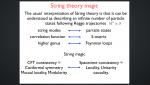
Metastring theory and Modular spacetime
Laurent Freidel - Perimeter Institute for Theoretical Physics
-
1PI Effective Action for Superstring Perturbation Theory
Ashoke Sen - Harish-Chandra Research Institute
-

Mass renormalization and vacuum shift using Off-shell string theory
Arnab Rudra - University of Cambridge
-

-
-
Superstring amplitudes in the operator formalism
Rodolfo Russo - Queen Mary University of London
-

-
-
Modular structure of Type IIB superstrings in the low energy expansion
Eric D'Hoker - University of California, Los Angeles
-
-
M-theory and G2 manifolds
Katrin Becker - Texas A&M University
The uplift of classical solutions of M-theory to the quantum theory will be discussed -
-
Metastring theory and Modular spacetime
Laurent Freidel - Perimeter Institute for Theoretical Physics
In this talk I will review a recent reformulation of string theory which does not rely on an a priori space-time interpretation or a pre-assumption of locality and include form the onset stringy symmetries such as T-duality. I will explain how this resulting theory, called metastring, leads to… -
1PI Effective Action for Superstring Perturbation Theory
Ashoke Sen - Harish-Chandra Research Institute
-
Mass renormalization and vacuum shift using Off-shell string theory
Arnab Rudra - University of Cambridge
The conventional on-shell techniques of computing string theory amplitudes is not sufficient to compute mass renormalization of massive states and vacuum shift in string theory. The aim of this talk is to define a suitable off-shell continuation of Polyakov approach. Then this off-shell continuation… -
-
-
Superstring amplitudes in the operator formalism
Rodolfo Russo - Queen Mary University of London
The operator formalism provides a constructive approach to superstring amplitudes that has two main virtues: it makes it possible to study explicitly all the degeneration limits and it is flexible enough to work in different setups. I will illustrate these two features in a concrete example: the… -