
Foil theories sometimes called mathematically rigorous science fiction describe ways the world could have been were it not quantum mechanical. Our understanding of quantum theory has been deepened by contrasting it with these alternatives. So far observers in foil theories have only been modeled implicitly for example via the recorded probabilities of observing events. Even when multi-agent settings are considered these agents tend to be compatible in the classical sense that they could always compare their observations. Scenarios where agents and their memories are themselves modeled as physical systems within the theory (and could in particular measure each other as in Wigner's friend experiment) have not yet been considered. In this workshop we will investigate which foil theories allow for the existence of explicit observers and whether they allow for paradoxes in multi-agent settings such as those found in quantum theory. We will also investigate which interpretations of quantum theory would equally well interpret the foil theories and which interpretations are truly quantum. We will gain a deeper understanding of how this can happen by discussing appropriate definitions observers in these theories and seeing how such observers learn about their environment.
Format results
-
Wavefunction branches as a foundation for constructing foil theories
Jess Riedel NTT Research
PIRSA:18040082 -
Compatibility of implicit and explicit observers in quantum theory and beyond
Thomas Galley Austrian Academy of Sciences
PIRSA:18040084 -
From observers to physics via algorithmic information theory I
Markus Müller Austrian Academy of Sciences
PIRSA:18040078 -
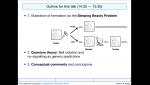
From observers to physics via algorithmic information theory II
Markus Müller Austrian Academy of Sciences
PIRSA:18040080 -
Motility of the internal-external cut as a foundational principle
Robert Spekkens Perimeter Institute for Theoretical Physics
PIRSA:18040073 -
-
Quantum theory cannot consistently describe the use of itself
Renato Renner ETH Zurich
PIRSA:18040085 -
-
-
Agents, Subsystems, and the Conservation of Information
Giulio Chiribella University of Hong Kong (HKU)
PIRSA:18040089 -
Microcanonical thermodynamics in general physical theories
Carlo Maria Scandolo University of Oxford
PIRSA:18040091