
We are entering an exponentially growing phase of gravitational-wave (GW) astronomy excitingly represented by the Nobel Prize in Physics last year - only two years after the first detection. The successful multi-messenger detection of binary neutron star merger in last August has triggered increasing interests to probe the neutron star post-merger gravitational radiations as they will give more decisive and informative description of the post-merger object itself and the GW/electromagnetic emission mechanism. As the post-merger GWs mainly lie in the 1kHz-4kHz band it becomes necessary and important to think about possible third-generation GW detectors that are primarily sensitive to the high frequency band. In this workshop we shall focus on possible science case and detector configuration for kHz high-frequency detectors. We will have several invited talks while leaving more time for free discussions. We hope this workshop can serve as a seed for much broader discussions in the GW astronomy community and help promote high frequency detectors as one of the development directions of third-generation GW detectors.
Format results
-
-
Hitting the High Notes: The High Frequency Dynamics of Neutron Star Mergers
William East Perimeter Institute for Theoretical Physics
PIRSA:18060045 -
Post-Merger Gravitational Wave Emission
Andreas Bauswein Max Planck Institute for Astrophysics (MPA), Garching
PIRSA:18060046 -
Searching for Ultralight Particles with Gravitational Waves
Masha Baryakhtar University of Washington
PIRSA:18060047 -
3G Detectors, Voyager
Rana Adhikari California Institute of Technology (Caltech) - Division of Physics Mathematics & Astronomy
PIRSA:18060048 -
Discussion Session
PIRSA:18060049 -
Gravitational Wave Telescopes: Some Cosmological Considerations
Latham Boyle University of Edinburgh
PIRSA:18060050 -
Astrophysics and Cosmology with Gravitational-Wave Population Inference
Eric Thrane Monash University - Department of Physics
PIRSA:18060051 -
Astrophysically Motivated Metrics for Designing the Next Generation of Gravitational-Wave Interferometers
Francisco Hernandez Vivanco Monash University - Department of Physics
PIRSA:18060052 -
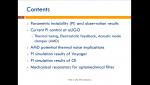
-
Optomechanics and Filters with Micromirrors
PIRSA:18060054 -

Discussion Session
PIRSA:18060055