Format results
-
An algebra of proper observables at null infinity: Dirac brackets, Memory and Goldstone probes
Rodrigo Andrade E Silva - Perimeter Institute for Theoretical Physics
-
-
-
Comments on overlaps in de Sitter gravity and the no-boundary state
Kristan Jensen - University of Victoria
-
From UV completeness to black hole physics: lessons from Hořava Gravity and Asymptotic Safety
Francesco Del Porro - University of Copenhagen
-
How to count states in gravity
Vijay Balasubramanian
-
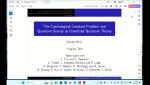
Spacetime foam and the cosmological constant
Steve Carlip - University of California, Davis
-
-
Subregion algebras in classical and quantum gravity
Venkatesa Chandrasekaran - University of California, Berkeley
-
Dressing up naked singularities
Marija Tomašević - University of Amsterdam
-
Quantum Corner Algebra(s): A Proposal
Jerzy Kowalski-Glikman - University of Wrocław
-
Towards the Quantization of Cylindrically Symmetric Spacetimes
Javier Peraza - Perimeter Institute for Theoretical Physics
-
An algebra of proper observables at null infinity: Dirac brackets, Memory and Goldstone probes
Rodrigo Andrade E Silva - Perimeter Institute for Theoretical Physics
The gravitational memory problem is typically phrased in terms of the failure of constructing a (separable) Hilbert space for radiative gravitational modes at null infinity containing distinct memory states. There is, in a sense, a classical version of this problem: so far, there is no completely… -
The gravitational S-matrix from the path integral: asymptotic symmetries and soft theorems
The classical action, or more generally the path integral, is a convenient framework for extracting the physical consequences of symmetries. In recent years, new symmetries of gravity in asymptotically flat spacetime have been uncovered based on relations to soft theorems governing the S-matrix. I… -
Can a multiverse theory explain the H_0 tension, the S_8 tension, the w(z) < -1 behavior and many other cosmological observations? Maybe!
Jan Ambjorn - University of Copenhagen
A simple multiverse model explains the late time exponential expansion of our universe without the need of a cosmological constant. Assuming that the local measurement of H_0 is correct, it also give a better fit to data than the standard LCDM model, as well as a z-dependent state parameter w(z)… -
Comments on overlaps in de Sitter gravity and the no-boundary state
Kristan Jensen - University of Victoria
I will discuss some aspects of quantum mechanics at late time in de Sitter space, focusing on the norm of the no-boundary state in semiclassical gravity. -
From UV completeness to black hole physics: lessons from Hořava Gravity and Asymptotic Safety
Francesco Del Porro - University of Copenhagen
In the search for a consistent and renormalizable quantum theory of gravity, a conservative possibility is that gravity admits a field-theoretic description valid up to arbitrarily high energies. This amounts to going beyond the perturbative non-renormalizability of general relativity and it can be… -
How to count states in gravity
Vijay Balasubramanian
Gibbons and Hawking proposed that the Euclidean gravity path integral with periodic boundary conditions in time computes the thermal partition sum of gravity. As a corollary, they argued that a derivative of the associated free energy with respect to the Euclidean time period computes gravitational… -
Spacetime foam and the cosmological constant
Steve Carlip - University of California, Davis
Suppose our universe really had a huge cosmological constant. What would this mean observationally? For a homogeneous universe the answer is clear, but if the universe is inhomogeneous at the Planck scale the question becomes more subtle. At the level of initial data, $\Lambda$ can be "hidden" in… -
Inroads into Ghost-free Euclidean and Lorentzian Quantum Gravity
Gabriel Assant
Higher-curvature gravity can offer UV completions of GR, but generically suffers from 4th-order propagating degrees of freedom often spoiling unitarity, e.g. Stelle gravity. Recently it was noticed that “Einsteinian gravities” allow for higher curvature interactions match Einstein’s spectrum at the… -
Subregion algebras in classical and quantum gravity
Venkatesa Chandrasekaran - University of California, Berkeley
We study subregion algebras in classical and perturbative quantum gravity on half-spaces of event horizons. We construct half-sided supertranslation generators by extending subregion phase spaces of the event horizon to include doubled pairs of edge modes obtained from splitting the horizon. These… -
Dressing up naked singularities
Marija Tomašević - University of Amsterdam
Small naked singularities—those not shielded by a macroscopic event horizon—are ubiquitous in classical General Relativity. Their existence constitutes apparent violations of the weak cosmic censorship conjecture, which asserts that physically reasonable solutions should appear regular to asymptotic… -
Quantum Corner Algebra(s): A Proposal
Jerzy Kowalski-Glikman - University of Wrocław
In this talk, I will argue that the universal structure of the corner algebra offers a new perspective on quantum gravity, in which the representation theory of this algebra plays a role as fundamental as that of the Poincaré algebra in quantum field theory. I will discuss the representation theory… -
Towards the Quantization of Cylindrically Symmetric Spacetimes
Javier Peraza - Perimeter Institute for Theoretical Physics
In this talk, we will provide an overview of recent developments in the quantization of Cylindrically symmetric spacetimes, which contain the Einstein-Rosen gravitational waves. This class of solutions leads to an integrable field theory, and its phase space can be expressed directly in terms of…