Format results
-
Ten Theses on Black Hole Entropy
Rafael Sorkin - Perimeter Institute for Theoretical Physics
-

LQG Black Holes
Leonardo Modesto - Southern University of Science and Technology (SUSTech)
-
Unitarity and Holography in Gravitational Physics
Donald Marolf - University of California, Santa Barbara
-
Black holes, fundamental destruction of information and conservation laws
Jonathan Oppenheim - University College London
-
Resolving the information paradox: the fuzzball proposal
Samir Mathur - Ohio State University
-
Black Hole Information - What's the Problem?
Sabine Hossenfelder - Ludwig-Maximilians-Universität München (LMU)
-
Matrix models for the black hole information paradox
Takuya Okuda - University of Tokyo
-
Schwarzschild radius and black hole thermodynamics with alpha' corrections from simulations of SUSY matrix quantum mechanics
Jun Nishimura - High Energy Accelerator Research Organization (KEK)
-

Black holes as mirrors
Patrick Hayden - Stanford University
-
-
-
On Energy Extraction from Rotating Black Holes
Herman Verlinde - Princeton University
-
Ten Theses on Black Hole Entropy
Rafael Sorkin - Perimeter Institute for Theoretical Physics
I present a viewpoint on black hole thermodynamics according to which the entropy: derives from horizon 'degrees of freedom''; is finite because the deep structure of spacetime is discrete; is ``objective'' thanks to the distinguished coarse graining provided by the horizon; and obeys the second law… -
LQG Black Holes
Leonardo Modesto - Southern University of Science and Technology (SUSTech)
In this talk we introduce loop quantum gravity and we apply the theory to the black hole singularity problem. The Schwarzschild black hole solution inside the event horizon coincides with the Kantowski-Sachs space-time and we can study a simple spherically symmetric mini-superspace model. We show… -
Unitarity and Holography in Gravitational Physics
Donald Marolf - University of California, Santa Barbara
Because the gravitational Hamiltonian is a pure boundary term on-shell, asymptotic gravitational fields store information in a manner not possible in local field theories. Two properties follow from this purely gravitational behavior. The first, 'Boundary Unitarity,' holds under AdS-like boundary… -
Black holes, fundamental destruction of information and conservation laws
Jonathan Oppenheim - University College London
Theories which have fundamental information destruction or decoherence are motivated by the black hole information paradox. However they have either violated conservation laws, or are highly non-local. Here, we show that the tension between conservation laws and locality can be circumvented by… -
Resolving the information paradox: the fuzzball proposal
Samir Mathur - Ohio State University
String theory gives a consistent theory of quantum gravity, so we can ask about the nature of black hole microstates in this theory. Studies of extremal and near-extremal microstates indicate that these microstates do not have a traditional horizon, which would have no data about the microstate in… -
Black Hole Information - What's the Problem?
Sabine Hossenfelder - Ludwig-Maximilians-Universität München (LMU)
I will classify the options to solve the black hole information loss problem by how radical a departure from semi-classical gravity they require outside the quantum gravitational regime. I will argue that the most plausible and conservative conclusion is that the problem of information loss… -
Matrix models for the black hole information paradox
Takuya Okuda - University of Tokyo
I'll discuss some large N quantum mechanical theories that are toy models for eternal black holes in AdS via gauge/gravity duality. They can be used to study the classical limit and quantum corrections in gravity, and their roles in the information paradox. We demonstrate that such large N models… -
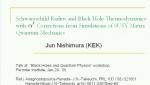
Schwarzschild radius and black hole thermodynamics with alpha' corrections from simulations of SUSY matrix quantum mechanics
Jun Nishimura - High Energy Accelerator Research Organization (KEK)
We present new results from our Monte Carlo simulation of SUSY matrix quantum mechanics with 16 supercharges at finite temperature. The internal energy can be fitted nicely to the behavior predicted from the dual black hole thermodynamics including the alpha' corrections. The temporal Wilson loop… -
Black holes as mirrors
Patrick Hayden - Stanford University
I'll discuss information retrieval from evaporating black holes, assuming that the internal dynamics of a black hole is unitary and rapidly mixing, and assuming that the retriever has unlimited control over the emitted Hawking radiation. If the evaporation of the black hole has already proceeded… -
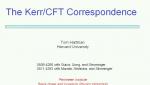
The Kerr/CFT Correspondence
Holography is usually applied to black holes that are supersymmetric, charged, or living in higher dimensions. The astrophysical Kerr black holes that have been observed in the sky have none of these nice properties, and AdS/CFT does not apply. Nevertheless, by studying the symmetries of the near… -
Black Holes as Fast Scramblers
We consider the problem of how fast a quantum system can scramble (thermalize) information, given that the interactions are between bounded clusters of degrees of freedom. Based on previous work, we conjecture: 1) The most rapid scramblers take a time logarithmic in the number of degrees of freedom… -
On Energy Extraction from Rotating Black Holes
Herman Verlinde - Princeton University
In this talk, I start with a short review of the available mechanisms for extracting energy from rotating black holes, in particular superradiance and the Blandford-Znajek process. I then describe how these mechanisms may be realized and studied via the AdS/CFT and Kerr/CFT correspondence.