Format results
-
Quantum Mechanics as a Theory of Systems with Limited Information Content
Časlav Brukner - Austrian Academy of Sciences
-
-
Quantum Theory from Entropic Inference
Ariel Caticha - State University of New York (SUNY)
-
Exact uncertainty, quantum mechanics and beyond
Michael Hall - Physikalisch-Technische Bundesanstalt (PTB)
-
Exact uncertainty, bosonic fields, and interacting classical-quantum systems
Marcel Reginatto - Physikalisch-Technische Bundesanstalt (PTB)
-

The power of epistemic restrictions in reconstructing quantum theory
Robert Spekkens - Perimeter Institute for Theoretical Physics
-
Steps Towards a Unified Basis.
Inge Helland - University of Oslo
-
Why Quantum Theory is Complex
Philip Goyal - State University of New York (SUNY)
-
-
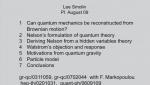
Reconstructing quantum theory from Brownian motion: an assessment
Lee Smolin - Perimeter Institute for Theoretical Physics
-
Four and a Half Axioms for Quantum Mechanics
Alexander Wilce - Susquehanna University
-
Quantum-Bayesian Coherence (or, My Favorite Convex Set)
Chris Fuchs - University of Massachusetts Boston
-
Quantum Mechanics as a Theory of Systems with Limited Information Content
Časlav Brukner - Austrian Academy of Sciences
I will consider physical theories which describe systems with limited information content. This limit is not due observer's ignorance about some “hidden” properties of the system - the view that would have to be confronted with Bell's theorem - but is of fundamental nature. I will show how the… -
The quantum logical reconstruction from Rovelli's axioms and its limits
Alexei Grinbaum - CEA Saclay
What belongs to quantum theory is no more than what is needed for its derivation. Keeping to this maxim, we record a paradigmatic shift in the foundations of quantum mechanics, where the focus has recently moved from interpreting to reconstructing quantum theory. We present a quantum logical… -
Quantum Theory from Entropic Inference
Ariel Caticha - State University of New York (SUNY)
Non-relativistic quantum theory is derived from information codified into an appropriate statistical model. The basic assumption is that there is an irreducible uncertainty in the location of particles so that the configuration space is a statistical manifold with a natural information metric. The… -
Exact uncertainty, quantum mechanics and beyond
Michael Hall - Physikalisch-Technische Bundesanstalt (PTB)
The fact that quantum mechanics admits exact uncertainty relations is used to motivate an ‘exact uncertainty’ approach to obtaining the Schrödinger equation. In this approach it is assumed that an ensemble of classical particles is subject to momentum fluctuations, with the strength of the… -
Exact uncertainty, bosonic fields, and interacting classical-quantum systems
Marcel Reginatto - Physikalisch-Technische Bundesanstalt (PTB)
The quantum equations for bosonic fields may be derived using an 'exact uncertainty' approach [1]. This method of quantization can be applied to fields with Hamiltonian functionals that are quadratic in the momentum density, such as the electromagnetic and gravitational fields. The approach, when… -
The power of epistemic restrictions in reconstructing quantum theory
Robert Spekkens - Perimeter Institute for Theoretical Physics
A significant part of quantum theory can be obtained from a single innovation relative to classical theories, namely, that there is a fundamental restriction on the sorts of statistical distributions over classical states that can be prepared. (Such a restriction is termed “epistemic” because it… -
Steps Towards a Unified Basis.
Inge Helland - University of Oslo
A new foundation of quantum mechanics for systems symmetric under a compact symmetry group is proposed. This is given by a link to classical statistics and coupled to the concept of a statistical parameter. A vector \phi of parameters is called an inaccessible c-variable if experiments can be… -
Why Quantum Theory is Complex
Philip Goyal - State University of New York (SUNY)
Complex numbers are an intrinsic part of the mathematical formalism of quantum theory, and are perhaps its most mysterious feature. We show that it is possible to derive the complex nature of the quantum formalism directly from the assumption that a pair of real numbers is associated to each… -
Quantum Mechanics as a Real-Vector-Space Theory with a Universal Auxiliary Rebit
William Wootters - Williams College
In a 1960 paper, E. C. G. Stueckelberg showed how one can obtain the familiar complex-vector-space structure of quantum mechanics by starting with a real-vector-space theory and imposing a superselection rule. In this talk I interpret Stueckelberg’s construction in terms of a single auxiliary real… -
Reconstructing quantum theory from Brownian motion: an assessment
Lee Smolin - Perimeter Institute for Theoretical Physics
TBA -
Four and a Half Axioms for Quantum Mechanics
Alexander Wilce - Susquehanna University
I will discuss a set of strong, but probabilistically intelligible, axioms from which one can {\em almost} derive the appratus of finite dimensional quantum theory. These require that systems appear completely classical as restricted to a single measurement, that different measurements, and likewise… -
Quantum-Bayesian Coherence (or, My Favorite Convex Set)
Chris Fuchs - University of Massachusetts Boston
In a quantum-Bayesian delineation of quantum mechanics, the Born Rule cannot be interpreted as a rule for setting measurement-outcome probabilities from an objective quantum state. (A quantum system has potentially as many quantum states as there are agents considering it.) But what then is the role…