The workshops focuses on novel frontiers in observational cosmology and astrophysics and how they shed light fundamental questions in understanding the universe. Registration for this workshop is now open.
Format results
-
CPT-Symmetric Universe
Latham Boyle - University of Edinburgh
-
Brane cosmology and the self-tuning of the cosmological constant
Francesco Nitti - Université Paris Cité
-
New Physics in the Rayleigh-Jeans tale of the CMB and cosmic 21cm signal
Maxim Pospelov - University of Minnesota
-
Gravitational waves in the inhomogeneous Universe
Masamune Oguri - University of Tokyo
-
-
Discussion: Where in the Cosmos should we look for novel physics?
Elias Kiritsis - University of Crete
-
Gravitational wave standard sirens
Samaya Nissanke - University of Amsterdam
-
Cosmology and fundamental physics with FRBs
Ue-Li Pen - University of Toronto
-
CHIME: The Canadian Hydrogen Intensity Mapping Experiment
Kendrick Smith - Perimeter Institute for Theoretical Physics
-
The Planck Legacy: Inflation and the Origin of Structure in the Universe
George Efstathiou - University of Cambridge
-
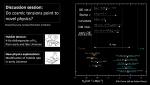
Discussion: Do cosmic tensions point to novel physics?
Lena Funcke - University of Bonn
-
First Science Results from the EHT
Avery Broderick - University of Waterloo
-
CPT-Symmetric Universe
Latham Boyle - University of Edinburgh
I will introduce our recent proposal that the state of the universe does *not* spontaneously violate CPT. Instead, the universe after the big bang is the CPT image of the universe before it, both classically and quantum mechanically. The pre- and post-bang epochs comprise a universe/anti-universe… -
Brane cosmology and the self-tuning of the cosmological constant
Francesco Nitti - Université Paris Cité
-
New Physics in the Rayleigh-Jeans tale of the CMB and cosmic 21cm signal
Maxim Pospelov - University of Minnesota
-
Gravitational waves in the inhomogeneous Universe
Masamune Oguri - University of Tokyo
The discovery of gravitational waves from a binary black hole merger in 2015 opened up a new window to study the Universe, including the origin of black holes, the nature of dark matter, and the expansion history of the Universe. However, gravitational waves emitted from binary mergers propagate… -
Weak Gravity Conjecture From Amplitudes’ Positivity
Brando Bellazzini - CEA Saclay
I will show how to derive new positivity bounds for scattering amplitudes in theories with a massless graviton in the spectrum in four spacetime dimensions. The bounds imply that extremal black holes are self-repulsive, M/|Q| -
Discussion: Where in the Cosmos should we look for novel physics?
Elias Kiritsis - University of Crete
-
-
Cosmology and fundamental physics with FRBs
Ue-Li Pen - University of Toronto
FRBs are the only known sources of extragalactic coherent radiation, that show interference phenomena after traveling over cosmological distances. The interferometric probe allows equivalent strain measurements of $h\sim 10^{-26}$, opening new windows for gravitational wave detection, dark matter… -
CHIME: The Canadian Hydrogen Intensity Mapping Experiment
Kendrick Smith - Perimeter Institute for Theoretical Physics
CHIME is a new interferometric telescope at radio frequencies 400-800 MHz. The mapping speed (or total statistical power) of CHIME is among the largest of any radio telescope in the world, and the technology powering CHIME could be used to build telescopes which are orders of magnitude more powerful… -
The Planck Legacy: Inflation and the Origin of Structure in the Universe
George Efstathiou - University of Cambridge
-
-