There has been a surge of interest in indefinite causal structure the idea that cause and effect can no longer be sharply distinguished. Motivated both by experimentation with quantum switches and quantum gravity there can be situations in which there is no matter-of-the-fact as to what the causal structure of spacetime is. This meeting will bring together workers in Quantum Foundations and Quantum Gravity in both theoretical experimental physics to discuss the state of the art of current research and set new directions for this emerging subdiscipline.
Format results
-

-
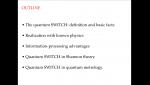
10 years of the quantum SWITCH: state of the art and new perspectives
Giulio Chiribella - University of Hong Kong (HKU)
-
Cyclic quantum causal models and violations of causal inequalities
Ognyan Oreshkov - Université Libre de Bruxelles
-
TBA
Laura Henderson - University of Waterloo
-
Composing causal orderings
Aleks Kissinger - University of Oxford
-
Quantum principle of relativity
Andrzej Dragan - University of Warsaw
-
-
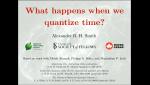
What happens when we quantize time?
Alexander Smith - Saint Anselm College
-
-
-
TBA
Christina Giarmatzi - University of Queensland
-
Unscrambling the Omelette of Causation and Inference in Operational and Ontological Theories
David Schmid - Perimeter Institute for Theoretical Physics
-
-
10 years of the quantum SWITCH: state of the art and new perspectives
Giulio Chiribella - University of Hong Kong (HKU)
The quantum SWITCH is the simplest example of indefinite causal structure. Technically, it is a higher-order transformation that takes two physical processes A and B in input and combines them in a coherent superposition of two alternative orders, AB and BA. In the past decade, the quantum SWITCH… -
Cyclic quantum causal models and violations of causal inequalities
Ognyan Oreshkov - Université Libre de Bruxelles
I will present an extension of the recent theory of quantum causal models to cyclic causal structures. This offers a novel causal perspective on processes beyond those corresponding to standard circuits, such as processes with dynamical causal order and causally nonseparable processes, including… -
-
Composing causal orderings
Aleks Kissinger - University of Oxford
When studying (definite or indefinite) causal orderings of processes, it is often useful to consider higher-order processes, i.e. processes which take other processes as their input. However, as a recent no-go result of Guerin et al indicates, our naive first-order notions of "composition" of… -
-
Quantum mechanics and the covariance of physical laws in quantum reference frames
Flaminia Giacomini - ETH Zurich
In physics, every observation is made with respect to a frame of reference. Although reference frames are usually not considered as degrees of freedom, in all practical situations it is a physical system which constitutes a reference frame. Can a quantum system be considered as a reference frame and… -
What happens when we quantize time?
Alexander Smith - Saint Anselm College
The lesson of general relativity is background independence: a physical theory should not be formulated in terms of external structures. This motivates a relational approach to quantum dynamics, which is necessary for a quantum theory of gravity. Using a covariant POVM to define a time observable, I… -
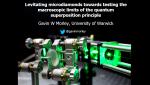
Levitating microdiamonds towards testing the macroscopic limits of the quantum superposition principle
Gavin Morley - University of Warwick
We are building an experiment in which a levitated 1 µm diamond containing a nitrogen vacancy (NV) centre would be put into a spatial quantum superposition [1-3]. This would be able to test theories of spontaneous wavefunction collapse [4]. We have helped theory collaborators to propose how to do… -
-
-
Unscrambling the Omelette of Causation and Inference in Operational and Ontological Theories
David Schmid - Perimeter Institute for Theoretical Physics
I will discuss how the standard frameworks for operational theories involve a scrambling of causal and inferential concepts. I will then present a new framework for operational theories which separates out the inferential and the causal aspects of a given physical theory. Generalized probabilistic…