Format results
-
Harnessing the whole power of CMB Lensing with the Atacama Cosmology Telescope
Irene Abril Cabezas - University of Cambridge
-
Cosmology with small-scale structure
Sten Delos - Carnegie Institution for Science
-
-
Measuring the Hubble Constant Without the Sound Horizon: A New Constraint from DESI
Erik Zaborowski - Ohio State University
-
Simulating and Reconstructing the Primordial Universe
Andrew Jamieson
-
Bringing the Cosmological collider into the Nonlinear Universe
Dhayaa Anbajagane - University of Chicago
-
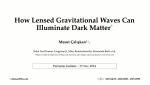
Beyond Gaussianity in Gravitational-Wave Data: Deciphering the Symphony of Black Holes and the Early Universe
Mesut Çalışkan - Johns Hopkins University - Department of Physics & Astronomy
-
TBA - Cosmology and Gravitation Seminar
Yurii Kvasiuk - University of Wisconsin–Madison - Department of Physics
-
Dark Matter Clues from the Faintest Galaxies
Julio Navarro - University of Victoria
-
-
Clustering from the Local Universe to Cosmic Dawn
Christian Jespersen - Princeton University
-
-
Harnessing the whole power of CMB Lensing with the Atacama Cosmology Telescope
Irene Abril Cabezas - University of Cambridge
Weak gravitational lensing of the CMB has been established as a robust and powerful observable for precision cosmology. By mapping the matter distribution, it provides a clean window to measure structure growth and key cosmological parameters such as the neutrino mass. In this talk, I will present… -
Cosmology with small-scale structure
Sten Delos - Carnegie Institution for Science
The first and smallest systems of particle dark matter gravitationally condensed directly out of the smooth mass distribution of the early universe. This formation mechanism left these "prompt cusps" with uniquely compact r^-1.5 density profiles and linked their properties tightly with the cosmic… -
Multiprobe cosmology with contemporary and future datasets
Multiprobe techniques are at the forefront of modern cosmological analysis. In this talk, I will demonstrate the advantages of the multiprobe approach for assessing internal consistency, mitigating systematic effects, and breaking parameter degeneracies across datasets spanning different scales and… -
Measuring the Hubble Constant Without the Sound Horizon: A New Constraint from DESI
Erik Zaborowski - Ohio State University
The Hubble tension, recently reaching as high as 7σ, increasingly presents a challenge to the ΛCDM model. A key question is whether this tension stems from our use of the sound horizon as a standard ruler. In this talk, I will present a new, sub-2% measurement of the Hubble constant (H₀) that is… -
Simulating and Reconstructing the Primordial Universe
Andrew Jamieson
Maximizing our chances of discovering new physics from next-generation cosmological surveys requires making robust theoretical predictions of the nonlinear processes governing both the early Universe and the late-time large-scale structure. In this talk, I will present advances in two complementary… -
Bringing the Cosmological collider into the Nonlinear Universe
Dhayaa Anbajagane - University of Chicago
Primordial non-Gaussianities (PNGs) are imprints in the density field caused by particle interactions during the inflationary epoch. A subclass of these signatures ("cosmological colliders") encode information about the interactions and properties of any additional particle fields present during… -
Beyond Gaussianity in Gravitational-Wave Data: Deciphering the Symphony of Black Holes and the Early Universe
Mesut Çalışkan - Johns Hopkins University - Department of Physics & Astronomy
Upcoming gravitational-wave detectors offer unprecedented potential for probing early-universe physics. They are expected to be sensitive to a wide range of primordial stochastic gravitational-wave backgrounds generated by processes such as inflationary dynamics, phase transitions, and cosmic… -
TBA - Cosmology and Gravitation Seminar
Yurii Kvasiuk - University of Wisconsin–Madison - Department of Physics
-
Dark Matter Clues from the Faintest Galaxies
Julio Navarro - University of Victoria
Lambda Cold Dark Matter (LCDM) is the most successful theory for the formation of structure in the Universe. Although its predictions have been verified on large scales, they are still contested on the scale of dwarf galaxies, whose dynamical properties are often cited as evidence for the need to… -
High-Dimensional Bayesian Inference for Astronomical Imaging and Strong Gravitational Lensing.
Modern telescopes such as Hubble and JWST deliver exquisitely detailed images that encode rich information about galaxies, stars, and dark matter. Extracting this information requires solving high-dimensional inverse problems in which each pixel represents a parameter of the sky. In this talk, I… -
Clustering from the Local Universe to Cosmic Dawn
Christian Jespersen - Princeton University
Galaxy science and cosmology are rapidly extending to ever higher redshifts, where new observations have motivated a wide range of galaxy formation models. Because these models are all tuned to reproduce observed number densities, clustering provides the critical observable for breaking their… -
Cosmological Constraints from the High-resolution Lyman-α Forest with PRIYA at k = 1-8 h/Mpc
We present new cosmological constraints from the small-scale (k ~ 1-8 h/Mpc) Lyman-α forest 1D flux power spectrum (P1D), using high-resolution quasar spectra from XQ-100 and KODIAQ-SQUAD interpreted with the PRIYA simulation-based emulator. The Lyα P1D is a unique probe of structure formation on…