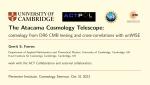
Format results
-
-
CMB-HD as a Probe of Dark Matter on Sub-Galactic Scales
Neelima Sehgal - Stony Brook University
-
Probes of cosmic inflation: from the CMB to quantum systems
Emilie Hertig - University of Cambridge
-
The speed of sound in the EFTofLSS
Caio B. de S. Nascimento - Perimeter Institute for Theoretical Physics
-
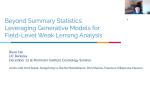
-
Probing Parity in the Cosmic Microwave Background (CMB)
Cyril Creque-Sarbinowski
-
How Lensed Gravitational Waves Can Illuminate Dark Matter
Mesut Caliskan
-
dRGT ghost-free massive gravity in spherical symmetry
Emma Albertini
-
Cosmology in the Era of Multi-Wavelength Surveys
Daisuke Nagai - Yale University
-
Geometric Machine Learning for cosmological galaxy models
Christian Jespersen - Princeton University
-
-
Cosmology from the DESI Data Release 1
Otavio Alves - University of Michigan–Ann Arbor
-
Untangling the Cosmic Web: Correlations between small-scale clustering and large-scale structure
Claire Lamman - Harvard University
Gravitational forces from the largest structures in the Universe leave a detectable imprint on galaxies and their local environment. I will present a new approach to tracing the tidal field using these correlations: the intrinsic alignment of small groups of galaxies, or "multipelts". Multiplets… -
CMB-HD as a Probe of Dark Matter on Sub-Galactic Scales
Neelima Sehgal - Stony Brook University
In this talk I will discuss the potential of future high-resolution CMB observations to probe structure on sub-galactic scales. In particular, I will discuss how a CMB-HD experiment can measure lensing over the range 0.005 h/Mpc < k < 55 h/Mpc, spanning four orders of magnitude, with a total lensing… -
Probes of cosmic inflation: from the CMB to quantum systems
Emilie Hertig - University of Cambridge
Polarization anisotropies of the cosmic microwave background (CMB) encode a wealth of information on fundamental physics. In the coming decade, a new generation of instruments starting with the Simons Observatory (SO) will either detect or tightly constrain the amplitude of B-mode patterns produced… -
The speed of sound in the EFTofLSS
Caio B. de S. Nascimento - Perimeter Institute for Theoretical Physics
The Effective Field Theory of Large Scale Structure (EFTofLSS) has found tremendous success as a perturbative framework for the evolution of large scale structure, and it is now routinely used to compare theoretical predictions against cosmological observations. The model for the total matter field… -
Revealing the information content of galaxy n-point functions with simulation-based inference
Beatriz Tucci
Improving cosmological constraints from galaxy clustering presents several challenges, particularly in extracting information beyond the power spectrum due to the complexities involved in higher-order n-point function analysis. In this talk, I will introduce novel inference techniques that allow us… -
Probing Parity in the Cosmic Microwave Background (CMB)
Cyril Creque-Sarbinowski
Deviations from a parity-symmetric Universe would strongly signal the presence of new physics beyond the Standard Model. The lowest-order scalar observable sensitive to parity in a homogeneous and isotropic Universe is the connected four-point function of a given cosmological field. Geometrically… -
-
dRGT ghost-free massive gravity in spherical symmetry
Emma Albertini
In my talk, I will argue that symmetry strongly changes the behaviour of massive gravity relative to its massless sibling. After reviewing the formulation of dRGT theory of ghost-free massive gravity, I will examine the minimal model and next-to-minimal model in spherical symmetry. Although the… -
Cosmology in the Era of Multi-Wavelength Surveys
Daisuke Nagai - Yale University
We are entering the golden age of multi-wavelength astronomical surveys. In the 2020s, a plethora of surveys (such as Euclid, eROSITA, Rubin-LSST, Simons Observatory, and CMB-S4) are underway or planned to provide unprecedented insights into cosmology and astrophysics. In this talk, I will discuss… -
Geometric Machine Learning for cosmological galaxy models
Christian Jespersen - Princeton University
Galaxies are the medium through which we study the structure of the universe. However, widely applied statistical models of galaxies are generally over-simplified: even recently proposed models cannot capture the dependencies on environment or formation history. To solve this problem, I will… -
Large Scale White Noise and Cosmology
Albert Stebbins
The generation of large scales white noise is a generic property of the dynamics of physical systems described by local non-linear partial differential equations. Non-linearities prevent the small scale dynamics to be erased by smoothing. Unresolved small scale dynamics act as an uncorrelated (white… -
Cosmology from the DESI Data Release 1
Otavio Alves - University of Michigan–Ann Arbor
On April 4th, 2024, the Dark Energy Spectroscopic Instrument (DESI) released its first set of cosmological results based on measurements of the baryon acoustic oscillations (BAO) scale in the spatial distribution of galaxies and quasars, and in the Lyman-alpha forest. Those measurements constrain…