Format results
-
-
Superconductivity and Charge Density Waves in the Clean 2D Limit
Adam Tsen - Institute for Quantum Computing (IQC)
-
Honeycomb lattice quantum magnets with strong spin-orbit coupling
Young-June Kim - University of Toronto
-
-
-
Stochastic Resonance Magnetic Force Microscopy: A Technique for Nanoscale Imaging of Vortex Dynamics
Raffi Budakian - Institute for Quantum Computing (IQC)
-
Spin Slush in an Extended Spin Ice Model
Jeff Rau - University of Waterloo
-
Universal Dynamic Magnetism in the Ytterbium Pyrochlores
Alannah Hallas - McMaster University
-
Spinon Walk in Quantum Spin Ice
Yuan Wan - Chinese Academy of Sciences
-
Disorder in spin liquids
Beyond their deceptively featureless ground states, spin liquids are particularly remarkable in the exotic nature of their (fractionalised and gauge charged) excitations. Quenched disorder can be instrumental in nucleating or localising defects with unusual properties, revealing otherwise hidden… -
Superconductivity and Charge Density Waves in the Clean 2D Limit
Adam Tsen - Institute for Quantum Computing (IQC)
We have recently demonstrated an experimental platform to isolate 2D materials that are unstable in the ambient environment. I will discuss our recent studies of the charge density wave compound 1T-TaS2 and superconducting 2H-NbSe¬ in the atomically thin limit, made possible using this technique. In… -
Honeycomb lattice quantum magnets with strong spin-orbit coupling
Young-June Kim - University of Toronto
In recent years, there has been much interest in honeycomb lattice quantum magnets described by Kitaev-Heisenberg Hamiltonian. For example, honeycomb lattice iridates, such as Na2IrO3 and Li2IrO3 have been intensely scrutinized. Recently, we proposed that a 4d honeycomb magnet α-RuCl3 is a promising… -
Organic materials: all-in-one systems for Mott physics - Quantum criticality, preformed pairs and spin liquids
Kazushi Kanoda - University of Tokyo
A many-body quantum system on the verge of instability between competing ground states exhibits emergent phenomena. Interacting electrons on triangular lattices are likely subjected to multiple instabilities in the charge and spin degrees of freedom, affording diverse phenomena related to the Mott… -
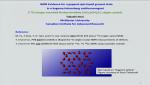
Evidence for a Gapped Spin Liquid Ground State in Herbertsmithite Kagome Heisenberg Antiferromagnet
Takashi Imai - McMaster University
The kagome lattice in a mineral compound "Herbertsmithite" represents structurally the most ideal kagome Heisenberg antiferromagnet known to date. Herbertsmithite does not undergo a magnetic long-range order or spin freezing at least down to ~J/2000. We will present 17-Oxygen and 2-Deuterium single… -
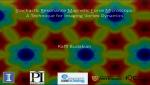
Stochastic Resonance Magnetic Force Microscopy: A Technique for Nanoscale Imaging of Vortex Dynamics
Raffi Budakian - Institute for Quantum Computing (IQC)
In this talk, I will describe a new technique—stochastic resonance magnetic force microscopy (SRMFM)—developed in my group for imaging the vortex dynamics in multiply connected superconducting devices. Unlike existing techniques, which directly image vortices, our technique relies on the mechanism… -
Spin Slush in an Extended Spin Ice Model
Jeff Rau - University of Waterloo
We introduce a new classical spin liquid on the pyrochlore lattice by extending spin ice with further neighbour interactions. This disorder-free spin model exhibits a form of dynamical heterogeneity with extremely slow relaxation for some spins while others fluctuate quickly down to zero temperature… -
Universal Dynamic Magnetism in the Ytterbium Pyrochlores
Alannah Hallas - McMaster University
The ytterbium pyrochlores, Yb2B2O7, are a family of materials with a remarkable diversity in their low-temperature physics. At the heart of their interesting physics is the proximity of their ground states to numerous competing phases. These proximate phases make the Yb pyrochlores very sensitive to… -
Spinon Walk in Quantum Spin Ice
Yuan Wan - Chinese Academy of Sciences
Quantum spin ice is a frustrated magnet that displays rich emergent phenomena. For example, the magnetic moments carried by the spins may separate into mobile magnetic charges, producing quantum fractional excitations known as spinons. The spinon moves in a background of disordered spins, and its…